Compilation··3:29·Number theory
Large Prime Gaps Have Positive Density, Artin's Primitive Root Conjecture and 8 More
Watch on YouTubeAbout the problem →
About this video
10 results from OpenAI's public mathematics catalogue, one per chapter. Each chapter names the problem, shows the real objects, and states what OpenAI claims; none of it is peer reviewed yet.
Chapters:
0:00 Patterson's Conjecture on Cubic Gauss Sums
0:20 Uchida's Conjecture
0:42 Erdős–Pomerance Conjecture
1:03 The Irrationality Exponent of π Is 2
1:24 Number of Totients
1:44 Short Egyptian Fractions
2:06 Large Prime Gaps Have Positive Density
2:27 Integral Points on Character Varieties of Curves
2:48 Artin's Primitive Root Conjecture
3:09 Modularity Over Imaginary Quadratic Fields
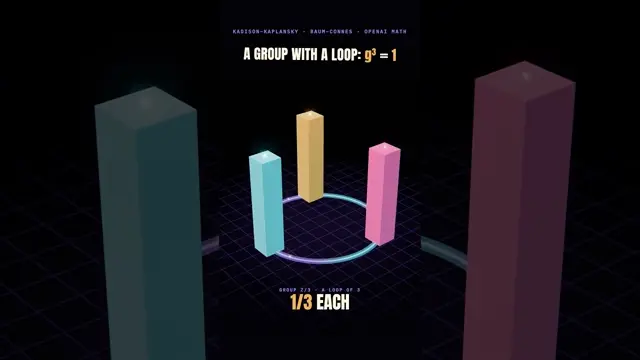
Patterson's Conjecture on Cubic Gauss Sums: Every Eisenstein prime gives a cubic Gauss sum, a point on the unit circle, and their angles look random.
Explained: gradientdamage.com/p/023
Paper: github.com/openai/math/blob/main/preprints/An-unconditional-f…
Uchida's Conjecture: Uchida's conjecture says that for huge Galois groups of number fields (solvably closed extensions), every continuous open homomorphism between them comes from exactly one field embedding running the other way: the…
Explained: gradientdamage.com/p/031
Paper: github.com/openai/math/blob/main/preprints/Open-Homomorphisms…
Erdős–Pomerance Conjecture: Take any whole number n and its neighbour n+1, and look at the largest prime factor of each.
Explained: gradientdamage.com/p/012
Paper: github.com/openai/math/blob/main/preprints/The-joint-Dickman-…
The Irrationality Exponent of π Is 2: How closely can a fraction p/q approach π? Dirichlet showed that infinitely many fractions get within 1/q², and the irrationality exponent of π measures whether any can do much better.
Explained: gradientdamage.com/p/017
Paper: github.com/openai/math/blob/main/preprints/The-irrationality-…
Number of Totients: Euler's totient of n counts the numbers up to n that share no factor with n.
Explained: gradientdamage.com/p/024
Paper: github.com/openai/math/blob/main/preprints/An-asymptotic-form…
Short Egyptian Fractions: An Egyptian fraction writes a number as a sum of distinct unit fractions 1/n.
Explained: gradientdamage.com/p/025
Paper: github.com/openai/math/blob/main/preprints/Short-Egyptian-fra…
Large Prime Gaps Have Positive Density: Near a prime p the average gap to the next prime is about log p.
Explained: gradientdamage.com/p/026
Paper: github.com/openai/math/blob/main/preprints/Positive-lower-den…
Integral Points on Character Varieties of Curves: Every way of twisting a once-punctured torus with 2 × 2 matrices of determinant one is recorded by three traces (x, y, z), and when the twist around the puncture has trace −2 those traces satisfy the Markoff equation x²…
Explained: gradientdamage.com/p/027
Paper: github.com/openai/math/blob/main/preprints/Integral-points-on…
Artin's Primitive Root Conjecture: Put the numbers 1 to p − 1 round a clock and keep multiplying by 2, wrapping round mod p.
Explained: gradientdamage.com/p/029
Paper: github.com/openai/math/blob/main/preprints/Primitive-roots-fo…
Modularity Over Imaginary Quadratic Fields: Fermat's Last Theorem was proved by showing that elliptic curves over the rational numbers are modular: the point counts of the curve modulo each prime match the coefficients of a modular form.
Explained: gradientdamage.com/p/030
Paper: github.com/openai/math/blob/main/preprints/Modularity-of-elli…
The animations illustrate the results; they are not proofs.
Gradient Damage: mathematics you can see, equations you can hear.
youtube.com/@gradientdamage
Chapters
One problem per chapter. Each name links to the result's own page, each time to that moment on YouTube.
- Patterson's Conjecture on Cubic Gauss Sums Number theory
- Uchida's Conjecture Number theory
- Erdős–Pomerance Conjecture Number theory
- The Irrationality Exponent of π Is 2 Number theory
- Number of Totients Number theory
- Short Egyptian Fractions Number theory
- Large Prime Gaps Have Positive Density Number theory
- Integral Points on Character Varieties of Curves Number theory
- Artin's Primitive Root Conjecture Number theory
- Modularity Over Imaginary Quadratic Fields Number theory
Chapter 1: about the problem
Number theory·OpenAI Math·Result 023
Patterson's first moment for cubic Gauss sums
Proves unconditionally the all-primary-prime form of Patterson’s first-moment asymptotic: normalized cubic Gauss sums over primary Eisenstein primes of norm at most X, including both conjugates, have an explicit positive main term of order X5/6/log X. Every fixed nonzero prime-angle Fourier mode has smaller order. (Lean)
Chapter 2: about the problem
Number theory·OpenAI Math·Result 031·from 0:20
Uchida’s conjecture for open homomorphisms of Galois groups
Proves Uchida's conjecture: every continuous open homomorphism between Galois groups of possibly infinite solvably closed Galois extensions of number fields comes from a unique equivariant field embedding in the opposite direction. No restriction on the kernel or separate cyclotomic-compatibility assumption is needed.
Chapter 3: about the problem
Number theory·OpenAI Math·Result 012·from 0:42
Independent largest prime factors of consecutive integers
Resolves the Erdős–Pomerance joint Dickman conjecture: the logarithmic sizes of the largest prime factors of n and n+1 are asymptotically independent in ordinary natural density. In particular, the integers satisfying P+(n) < P+(n+1) have density 1/2. (Lean)
Chapter 4: about the problem
Number theory·OpenAI Math·Result 017·from 1:03
The irrationality exponent of π is 2
Proves that the irrationality exponent of π is exactly 2: for every ε > 0 and all sufficiently large denominators q, every rational p/q satisfies |π-p/q| ≥ q-2-ε. This also proves convergence of the Flint–Hills series ∑n ≥ 11/(n3 sin2 n), with angles in radians. (Lean)
Chapter 5: about the problem
Number theory·OpenAI Math·Result 024·from 1:24
An asymptotic formula for the number of totients
Gives an asymptotic equivalent for the number V(x) of distinct totient values up to x, with a positive bounded phase-dependent factor determined by convergent arithmetic approximations. In particular, V(cx)/V(x) → c for every fixed c > 0, answering Erdős and Hall’s scaling question. (Lean)
Chapter 6: about the problem
Number theory·OpenAI Math·Result 025·from 1:44
Short Egyptian fractions
Every rational a/b with 1 ≤ a < b is a sum of O(log log b) distinct positive unit fractions. The worst-case minimum number of terms has the same order, resolving Erdős’s conjecture on short Egyptian fractions. (Lean)
Chapter 7: about the problem
Number theory·OpenAI Math·Result 026·from 2:06
Positive lower density of large prime gaps
For every fixed C > 0, a positive proportion of consecutive prime gaps exceed C log pn, throughout every sufficiently large initial segment of the primes. The proportion may depend on C. Consequently, the indices where pn/n increases have positive lower density, answering Erdős and Prachar. (Lean)
Chapter 8: about the problem
Number theory·OpenAI Math·Result 027·from 2:27
Potential integral density on curve character varieties
Resolves the determinant-one curve case of Litt's integral-density question. For every smooth connected complex algebraic curve and every rank, integral points become Zariski dense in every component of its SLr character variety over the full ring of integers of one number field. Prescribed quasi-unipotent boundary conjugacy classes are allowed, including nonsemisimple classes. (Lean)
Chapter 9: about the problem
Number theory·OpenAI Math·Result 029·from 2:48
Primitive roots for every admissible integer base
Proves the infinitude assertion in Artin's primitive root conjecture for every integer a that is neither −1 nor a square. For each such base, at least ca x/(log x)2 primes in every sufficiently large interval (x,2x) have primitive root a, with ca > 0.
Chapter 10: about the problem
Number theory·OpenAI Math·Result 030·from 3:09
Modularity of elliptic curves over imaginary quadratic fields
Proves the modularity conjecture for elliptic curves over imaginary quadratic fields: every elliptic curve over every imaginary quadratic field is modular, with matching local parameters at every place.
Topics
cubic Gauss sumsUchida's conjecturelargest prime factorirrationality exponent of piEuler's totient functionEgyptian fractionsprime gapscharacter varietyArtin's conjecturemodularity theoremNumber theoryOpenAI mathAI proofAI mathematicsmathsGradient Damage