Compilation··28:48·Number theory
Every OpenAI Math Result, Part 1 of 4: Goldfeld's Conjecture and 82 More
Watch on YouTubeAbout the problem →
About this video
Part 1 of 4: 83 results from OpenAI's public mathematics catalogue, one per chapter, in the order people search for them. Each chapter names the problem, shows the real objects, and states what OpenAI claims; none of it is peer reviewed yet. Every result has its own page: gradientdamage.com
Chapters:
0:00 Goldfeld's Conjecture
0:21 Deligne–Drinfeld Conjecture
0:42 Ostmann's Inverse Goldbach Conjecture
1:03 Restricted Geometric Langlands
1:23 Hodge Conjecture for CM Abelian Varieties
1:43 Quantum Geometric Langlands
2:05 Sensitivity Conjecture
2:26 Hadwiger's Conjecture
2:47 Van der Waerden Numbers
3:08 Erdős Distinct Distances, Higher Dimensions
3:29 Euclidean Ramsey Theory
3:50 Kadison–Kaplansky Conjecture
4:11 Kadison's Similarity Problem
4:33 Hyperinvariant Subspace Problem
4:54 Kadison–Ringrose Cohomology Conjecture
5:15 De Giorgi's Conjecture in Dimension 8
5:35 Milne's Rationality Conjecture
5:55 Chowla Conjecture, Two-Point Case
6:16 Bogomolov–Pop Conjecture
6:37 Fontaine–Mazur Conjecture at the Prime 2
6:57 Prime Factors of p−1
7:19 Duke's Theorem in Higher Degree
7:40 Zilber–Pink Conjecture
8:01 Margulis–Platonov Conjecture
8:23 Grothendieck's Section Conjecture
8:44 Squarefree Values of Quartics
9:05 Jacobsthal's Function
9:25 Duffin–Schaeffer Conjecture
9:45 Patterson's Conjecture on Cubic Gauss Sums
10:05 Uchida's Conjecture
10:27 Log Abundance Conjecture, Characteristic p
10:48 Ordinary Double Point Volume Gap
11:09 Fujita's Freeness Conjecture
11:29 Nagata's Conjecture
11:50 Bloch's Conjecture
12:11 Hyperkähler SYZ Conjecture
12:31 P = W Conjecture
12:51 Hikita Conjecture
13:12 Lipman–Zariski Conjecture
13:32 Stable Coordinate Conjecture
13:53 Griffiths' Positivity Conjecture
14:14 Kobayashi's Ampleness Conjecture
14:35 Kuznetsov Conjecture
14:56 Toda's Gepner Conjecture
15:17 Zariski's Multiplicity Conjecture
15:37 Global Spherical Shell Conjecture
15:57 LeBrun–Salamon Conjecture
16:19 Generalized Mukai Conjecture
16:40 The Mu-Constant Problem for Surfaces
17:00 Virasoro Conjecture
17:21 Campana–Peternell Conjecture in Dimension 6
17:42 Brennan's Conjecture
18:03 Falconer Distance Conjecture
18:23 L log L Fourier Convergence Conjecture
18:45 Bochner–Riesz Conjecture
19:05 Petty's Projection Conjecture
19:27 GNRS Conjecture for Planar Graphs
19:47 Triangular Lattice Universal Optimality
20:08 Log Brunn–Minkowski Conjecture
20:29 Covering Density of Convex Bodies
20:50 Dimension-Free Log-Sobolev Inequality
21:10 Gaussian Propeller Conjecture
21:31 Euclidean Steinitz–Bergström Bound
21:52 Lang–Plaut Problem
22:14 Edit Distance in ℓ1
22:35 Cylinder Covering
22:55 Simplex Conjecture for Isotropic Constants
23:15 Unique Games Conjecture
23:36 2-to-1 Games Conjecture
23:57 Coloring 3-Colorable Graphs
24:19 Permanent vs Determinant
24:40 Randomized k-Server Problem Solved
25:02 Matroid Prophet Inequality
25:22 Depth-3 Circuit Lower Bounds
25:42 Noncommutative Identity Testing
26:03 Bin Packing
26:24 Courtade–Kumar Conjecture
26:44 Maximum Matching in Almost Linear Time, Any Graph
27:05 Edit Distance
27:26 Trace Reconstruction
27:47 Three-Machine Scheduling
28:08 Metric k-Median
28:28 Shortest Common Superstring
The animations illustrate the results; they are not proofs.
Gradient Damage: mathematics you can see, equations you can hear.
youtube.com/@gradientdamage
Chapters
One problem per chapter. Each name links to the result's own page, each time to that moment on YouTube.
- Goldfeld's Conjecture Number theory
- Deligne–Drinfeld Conjecture Number theory
- Ostmann's Inverse Goldbach Conjecture Number theory
- Restricted Geometric Langlands Number theory
- Hodge Conjecture for CM Abelian Varieties Algebraic and complex geometry
- Quantum Geometric Langlands Algebraic and complex geometry
- Sensitivity Conjecture Theoretical computer science
- Hadwiger's Conjecture Combinatorics
- Van der Waerden Numbers Combinatorics
- Erdős Distinct Distances, Higher Dimensions Combinatorics
- Euclidean Ramsey Theory Combinatorics
- Kadison–Kaplansky Conjecture Operator algebras
- Kadison's Similarity Problem Operator algebras
- Hyperinvariant Subspace Problem Operator algebras
- Kadison–Ringrose Cohomology Conjecture Operator algebras
- De Giorgi's Conjecture in Dimension 8 Partial differential equations
- Milne's Rationality Conjecture Number theory
- Chowla Conjecture, Two-Point Case Number theory
- Bogomolov–Pop Conjecture Number theory
- Fontaine–Mazur Conjecture at the Prime 2 Number theory
- Prime Factors of p−1 Number theory
- Duke's Theorem in Higher Degree Number theory
- Zilber–Pink Conjecture Number theory
- Margulis–Platonov Conjecture Number theory
- Grothendieck's Section Conjecture Number theory
- Squarefree Values of Quartics Number theory
- Jacobsthal's Function Number theory
- Duffin–Schaeffer Conjecture Number theory
- Patterson's Conjecture on Cubic Gauss Sums Number theory
- Uchida's Conjecture Number theory
- Log Abundance Conjecture, Characteristic p Algebraic and complex geometry
- Ordinary Double Point Volume Gap Algebraic and complex geometry
- Fujita's Freeness Conjecture Algebraic and complex geometry
- Nagata's Conjecture Algebraic and complex geometry
- Bloch's Conjecture Algebraic and complex geometry
- Hyperkähler SYZ Conjecture Algebraic and complex geometry
- P = W Conjecture Algebraic and complex geometry
- Hikita Conjecture Algebraic and complex geometry
- Lipman–Zariski Conjecture Algebraic and complex geometry
- Stable Coordinate Conjecture Algebraic and complex geometry
- Griffiths' Positivity Conjecture Algebraic and complex geometry
- Kobayashi's Ampleness Conjecture Algebraic and complex geometry
- Kuznetsov Conjecture Algebraic and complex geometry
- Toda's Gepner Conjecture Algebraic and complex geometry
- Zariski's Multiplicity Conjecture Algebraic and complex geometry
- Global Spherical Shell Conjecture Algebraic and complex geometry
- LeBrun–Salamon Conjecture Algebraic and complex geometry
- Generalized Mukai Conjecture Algebraic and complex geometry
- The Mu-Constant Problem for Surfaces Algebraic and complex geometry
- Virasoro Conjecture Algebraic and complex geometry
- Campana–Peternell Conjecture in Dimension 6 Algebraic and complex geometry
- Brennan's Conjecture Real and complex analysis
- Falconer Distance Conjecture Real and complex analysis
- L log L Fourier Convergence Conjecture Real and complex analysis
- Bochner–Riesz Conjecture Real and complex analysis
- Petty's Projection Conjecture Convex and metric geometry
- GNRS Conjecture for Planar Graphs Convex and metric geometry
- Triangular Lattice Universal Optimality Convex and metric geometry
- Log Brunn–Minkowski Conjecture Convex and metric geometry
- Covering Density of Convex Bodies Convex and metric geometry
- Dimension-Free Log-Sobolev Inequality Convex and metric geometry
- Gaussian Propeller Conjecture Convex and metric geometry
- Euclidean Steinitz–Bergström Bound Convex and metric geometry
- Lang–Plaut Problem Convex and metric geometry
- Edit Distance in ℓ1 Convex and metric geometry
- Cylinder Covering Convex and metric geometry
- Simplex Conjecture for Isotropic Constants Convex and metric geometry
- Unique Games Conjecture Theoretical computer science
- 2-to-1 Games Conjecture Theoretical computer science
- Coloring 3-Colorable Graphs Theoretical computer science
- Permanent vs Determinant Theoretical computer science
- Randomized k-Server Problem Solved Theoretical computer science
- Matroid Prophet Inequality Theoretical computer science
- Depth-3 Circuit Lower Bounds Theoretical computer science
- Noncommutative Identity Testing Theoretical computer science
- Bin Packing Theoretical computer science
- Courtade–Kumar Conjecture Theoretical computer science
- Maximum Matching in Almost Linear Time, Any Graph Theoretical computer science
- Edit Distance Theoretical computer science
- Trace Reconstruction Theoretical computer science
- Three-Machine Scheduling Theoretical computer science
- Metric k-Median Theoretical computer science
- Shortest Common Superstring Theoretical computer science
Chapter 1: about the problem
Number theory·OpenAI Math·Result 006
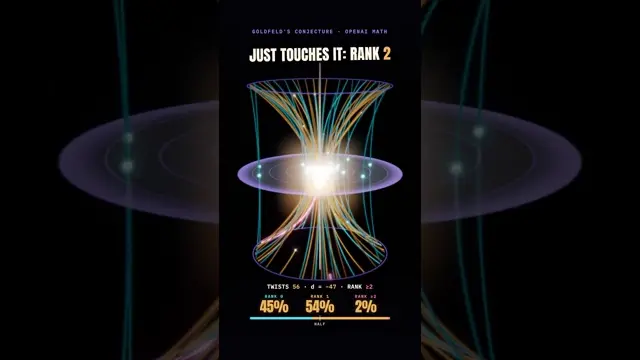
Goldfeld’s conjecture: densities and mean analytic rank
Proves Goldfeld's conjecture for quadratic twists of every elliptic curve over ℚ: analytic ranks zero and one each have density 1/2, and the mean analytic rank tends to 1/2. Both statements order signed squarefree twist parameters by absolute value.
Chapter 2: about the problem
Number theory·OpenAI Math·Result 008·from 0:21
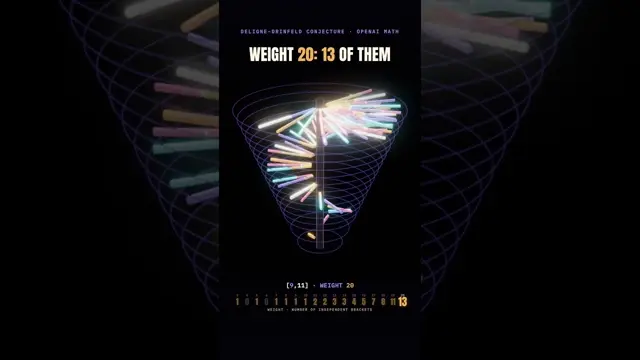
The Deligne–Drinfeld conjecture
Proves that the rational Grothendieck–Teichmüller Lie algebra, with the Ihara bracket, is freely generated by one element in each odd weight 3, 5, 7, …, resolving the Deligne–Drinfeld conjecture. (Lean)
Chapter 3: about the problem
Number theory·OpenAI Math·Result 013·from 0:42
Ostmann’s inverse Goldbach conjecture
Proves that no finite modification of the primes can be written as A+B with A,B ⊆ ℤ≥ 0 each containing at least two elements. This resolves Ostmann's inverse Goldbach conjecture on additive indecomposability. (Lean)
Chapter 4: about the problem
Number theory·OpenAI Math·Result 014·from 1:03
Restricted geometric Langlands, global Arthur enhancements, and generic Ramanujan
Proves the restricted geometric Langlands equivalence for connected reductive groups on smooth projective connected curves over 𝔽̅q under the four stated Lie-theoretic characteristic hypotheses. Over arbitrary algebraically closed fields of characteristic p > 0, the same conclusion holds assuming additionally that p is very good for the group and p∤ |WG|. Over global function fields, proves Ramanujan at every place for globally generic cuspidal representations of split adjoint absolutely simple exceptional groups, without characteristic or ramification-depth restrictions, and at every unramified place for cuspidal representations of split adjoint absolutely simple groups with a generic unramified component. Assuming the finite-level Ramanujan–Arthur decomposition, constructs global Arthur enhancements of occurring cuspidal excursion parameters for split connected semisimple groups at full finite level, recovering the given parameters by diagonal specialization on the entire Weil group, including inertia.
Chapter 5: about the problem
Algebraic and complex geometry·OpenAI Math·Result 032·from 1:23
The rational Hodge conjecture for CM abelian varieties
Proves the rational Hodge conjecture for every complex CM abelian variety, in every dimension and codimension. Through Milne's theorems, this also gives the Tate conjecture for all abelian varieties over finite fields and the Hodge standard conjecture for abelian varieties in every characteristic.
Chapter 6: about the problem
Algebraic and complex geometry·OpenAI Math·Result 069·from 1:43
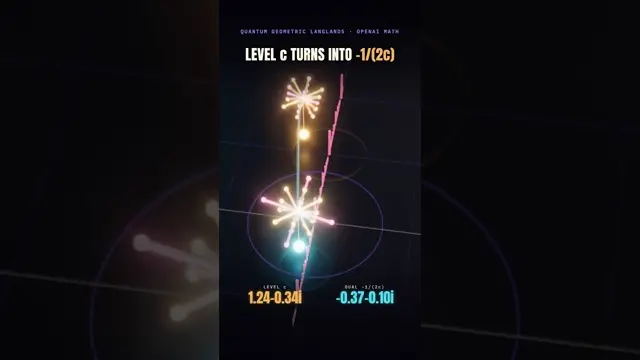
Global quantum geometric Langlands at irrational level
Proves the unramified de Rham quantum geometric Langlands equivalence for every connected simple complex algebraic group on every smooth projective connected complex curve, at every shifted level c ∈ ℂ∖ℚ. It identifies the full derived categories of twisted D-modules for the group and its Langlands dual, retaining all global forms and connected components.
Chapter 7: about the problem
Theoretical computer science·OpenAI Math·Result 132·from 2:05
A superquadratic separation of sensitivity and block sensitivity
Constructs total Boolean functions with block sensitivity bs (f) ≥ s(f)α for a fixed α > 2, disproving the quadratic strengthening of the Sensitivity Conjecture. Here s(f) counts influential individual-bit flips, while block sensitivity allows disjoint groups of bits to change together. (Lean)
Chapter 8: about the problem
Combinatorics·OpenAI Math·Result 157·from 2:26
Graph coloring, clique minors, and Colin de Verdière invariants
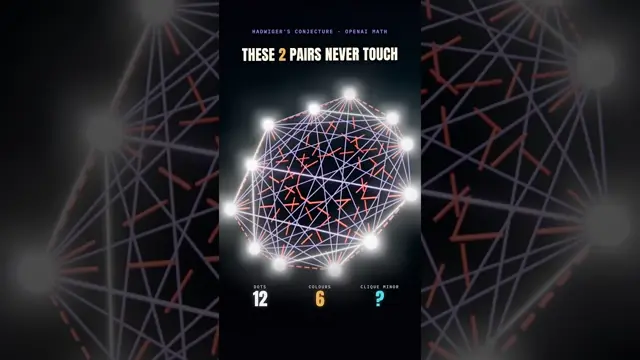
Disproves Hadwiger's conjecture even for fractional coloring: arbitrarily large finite simple graphs with independence number at most two satisfy χf(G) > h(G), where h(G) is the largest clique-minor order. Also disproves the fractional Colin de Verdière chromatic bound χf(G) ≤ μ(G)+1. In the positive direction, every finite nonempty graph satisfies χlist(G) ≤ C h(G) for a universal constant C. (Lean)
Chapter 9: about the problem
Combinatorics·OpenAI Math·Result 160·from 2:47
Superexponential van der Waerden numbers
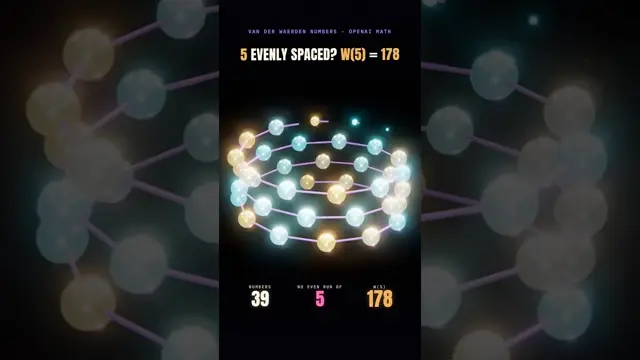
Resolves Erdős's superexponential-growth question for van der Waerden numbers. If Wr(k) is the least interval length forcing a monochromatic k-term progression in every r-coloring, then Wr(k) > kck⌊log2 r⌋ for an absolute c > 0, all r ≥ 2 and sufficiently large k, uniformly in r. In particular, Wr(k)1/k → ∞ for each fixed r. (Lean)
Chapter 10: about the problem
Combinatorics·OpenAI Math·Result 166·from 3:08
The higher-dimensional Erdős distinct-distances conjecture
For every fixed d ≥ 3, any n ≥ 2 distinct points in ℝd determine at least cdn2/d distinct distances, with cd > 0 depending only on dimension. This matches the integer-grid order and resolves the higher-dimensional Erdős distinct-distances conjecture with a constant-factor bound.
Chapter 11: about the problem
Combinatorics·OpenAI Math·Result 172·from 3:29
Classification of finite Euclidean Ramsey configurations
Classifies finite point configurations that occur monochromatically, at their original scale, in every finite coloring of sufficiently high-dimensional Euclidean space. The characterization is an algebraic condition over the coordinate field. It also disproves the Leader–Russell–Walters conjecture that every such configuration is a subset of a finite transitive set. (Lean)
Chapter 12: about the problem
Operator algebras·OpenAI Math·Result 285·from 3:50
Counterexamples to Baum–Connes and Kadison–Kaplansky
Disproves the coefficient-free reduced Baum–Connes conjecture through a failure of rational injectivity and a separate failure of surjectivity of assembly. A finitely generated torsion-free example witnesses the injectivity failure. Separately, a torsion-free group has a nontrivial projection in its reduced group C∗-algebra, disproving the Kadison–Kaplansky conjecture.
Chapter 13: about the problem
Operator algebras·OpenAI Math·Result 288·from 4:11
Kadison's similarity conjecture
Proves Kadison's similarity conjecture: every bounded complex-linear unital algebra homomorphism from a unital complex C∗-algebra to operators on a Hilbert space becomes a *-homomorphism after conjugation by a bounded invertible operator. (Lean)
Chapter 14: about the problem
Operator algebras·OpenAI Math·Result 293·from 4:33
Invariant projections, hyperinvariant subspaces, and transitive algebras
Constructs a nonzero norm-quasinilpotent operator on every infinite-dimensional separable complex Hilbert space with no nonzero proper closed subspace invariant under every commuting operator. The construction also gives operators with no nontrivial invariant projection in the hyperfinite type II1 factor. (Lean)
Chapter 15: about the problem
Operator algebras·OpenAI Math·Result 295·from 4:54
The Kadison–Ringrose cohomology conjecture
Proves that every bounded Hochschild cocycle of degree at least two on a complex von Neumann algebra, with coefficients in the algebra itself, has a bounded primitive. Equivalently, all higher bounded Hochschild cohomology groups vanish, resolving the Kadison–Ringrose conjecture. (Lean)
Chapter 16: about the problem
Partial differential equations·OpenAI Math·Result 375·from 5:15
De Giorgi's conjecture in dimension eight
Proves De Giorgi's conjecture at its sharp dimension-eight endpoint: every entire C2 solution u:ℝ8 → (-1,1) of Δ u=u3-u that is strictly increasing in one direction depends on only one linear coordinate. A stronger theorem classifies all stable entire solutions v:ℝ7 → [-1,1] as constant wells or planar transitions, without an energy-growth assumption.
Chapter 17: about the problem
Number theory·OpenAI Math·Result 001·from 5:35
Milne’s rationality conjecture and algebraic specialization
Proves Milne's rationality conjecture for abelian varieties over ℚ̅ with good reduction: specialized Hodge classes pair rationally with complementary divisor products, independently of cohomology theory. Together with result 032, every specialized Hodge class is represented by a single rational algebraic cycle simultaneously in all prime-to-p and crystalline realizations, for every residue characteristic p.
Chapter 18: about the problem
Number theory·OpenAI Math·Result 007·from 5:55
Ordinary two-point correlations and the corrected Elliott conjecture
Proves the ordinary two-point Chowla conjecture, with a bound O(X/(log X)c) for Liouville correlation sums along fixed nonproportional affine forms, where c > 0 is absolute. More generally, proves the binary corrected Elliott conjecture for complex multiplicative functions bounded by one when one factor is uniformly nonpretentious against each fixed Dirichlet character times nit for |t| ≤ X. (Lean)
Chapter 19: about the problem
Number theory·OpenAI Math·Result 009·from 6:16
Function-field reconstruction from Milnor K-theory and Galois data
Reconstructs function fields of transcendence degree at least two over algebraically closed constants from KM1/ℓ, KM2/ℓ, and their product. These data recover the perfect closure and constants when ℓ differs from the characteristic, and the original field and its named base in equal characteristic. Also proves Bogomolov–Pop reconstruction from abelian-by-central pro-ℓ Galois data away from the characteristic. (Lean)
Chapter 20: about the problem
Number theory·OpenAI Math·Result 010·from 6:37
Unrestricted pro-modularity at the prime two
Every continuous odd absolutely irreducible two-dimensional 2-adic representation of Gℚ unramified outside finitely many primes occurs in a completed Hecke algebra at some odd tame level. Also proves classical modularity up to Tate twist for irreducible odd representations with these finiteness conditions that are de Rham at 2 with distinct Hodge–Tate weights, resolving the dyadic Fontaine–Mazur case without residual restrictions.
Chapter 21: about the problem
Number theory·OpenAI Math·Result 011·from 6:57
Prime-factor statistics of p-1
Proves that the normalized ordered logarithms of the prime factors of p-1, counted with multiplicity, converge jointly to the Poisson–Dirichlet law PD(1) as p ranges uniformly over primes up to x and x → ∞. This resolves the Ford–Konyagin–Luca conjecture. It also proves that infinitely many integers n have more than n1-ε totient preimages, for every ε > 0.
Chapter 22: about the problem
Number theory·OpenAI Math·Result 015·from 7:19
Torus-packet equidistribution in prime, quartic, and sextic degrees
Proves Haar equidistribution without escape of mass for complete volume-weighted torus packets from totally real fields: arbitrary lattices and prescribed local types in fixed prime degree at least five, arbitrary-order Picard packets in primitive quartic fields, and maximal-order ideal-class packets in primitive sextic fields. Here primitive means having no proper intermediate field; the relevant order or field discriminant tends to infinity. (Lean)
Chapter 23: about the problem
Number theory·OpenAI Math·Result 016·from 7:40
Zilber–Pink in abelian varieties and the Siegel threefold
Proves the abelian Zilber–Pink conjecture over ℚ̅: every irreducible subvariety has finitely many maximal atypical subvarieties relative to its smallest containing torsion coset. It also proves the full curve case in the Siegel threefold 𝒜2 for Hodge-generic curves defined over ℚ̅, without boundary or reduction assumptions.
Chapter 24: about the problem
Number theory·OpenAI Math·Result 018·from 8:01
The Margulis–Platonov conjecture over global fields
Proves the Margulis–Platonov conjecture over every global field, including function fields of characteristic two. For an absolutely almost simple simply connected algebraic group G over k, every noncentral abstract normal subgroup of G(k) is the inverse image of an open normal subgroup in the finite product of its anisotropic nonarchimedean local groups.
Chapter 25: about the problem
Number theory·OpenAI Math·Result 019·from 8:23
The local p-adic section conjecture and global consequences
Proves that rational points on every smooth proper geometrically connected curve of genus at least two over a finite extension of ℚp correspond bijectively to conjugacy classes of sections of its full arithmetic étale fundamental group. It also proves Grothendieck's section conjecture over ℚ for the modular curves X0(N) and X1(N) of genus at least two.
Chapter 26: about the problem
Number theory·OpenAI Math·Result 020·from 8:44
Squarefree quartics and power-free polynomial values
Proves the squarefree-values conjecture for irreducible integer quartics with no fixed prime-square divisor: squarefree values on positive integers have the predicted positive Euler-product density. More generally, establishes the (d-2)-power-free density for irreducible integer polynomials of degrees four through eight under the necessary local condition; together with Browning's higher-degree theorem, this covers every d ≥ 4. (Lean)
Chapter 27: about the problem
Number theory·OpenAI Math·Result 021·from 9:05
A quadratic bound for Jacobsthal’s function
Answers Jacobsthal's quadratic-bound question: every interval of Ck2 consecutive integers contains an integer coprime to any prescribed positive integer with at most k distinct prime divisors, for an absolute constant C. The bound is uniform over prime sets and interval positions and removes the classical logarithmic loss. (Lean)
Chapter 28: about the problem
Number theory·OpenAI Math·Result 022·from 9:25
The weak inhomogeneous Duffin–Schaeffer conjecture
Proves that for every real shift γ and finite-valued ψ:ℕ → [0,∞), divergence of ∑qϕ(q)ψ(q)/q implies ‖qx-γ‖ < ψ(q) for infinitely many q, for almost every x. Here ϕ is Euler's totient and the norm is distance to the nearest integer. Numerators are unrestricted; no monotonicity or Diophantine condition on γ is needed.
Chapter 29: about the problem
Number theory·OpenAI Math·Result 023·from 9:45
Patterson's first moment for cubic Gauss sums
Proves unconditionally the all-primary-prime form of Patterson’s first-moment asymptotic: normalized cubic Gauss sums over primary Eisenstein primes of norm at most X, including both conjugates, have an explicit positive main term of order X5/6/log X. Every fixed nonzero prime-angle Fourier mode has smaller order. (Lean)
Chapter 30: about the problem
Number theory·OpenAI Math·Result 031·from 10:05
Uchida’s conjecture for open homomorphisms of Galois groups
Proves Uchida's conjecture: every continuous open homomorphism between Galois groups of possibly infinite solvably closed Galois extensions of number fields comes from a unique equivariant field embedding in the opposite direction. No restriction on the kernel or separate cyclotomic-compatibility assumption is needed.
Chapter 31: about the problem
Algebraic and complex geometry·OpenAI Math·Result 035·from 10:27
Log-canonical threefold abundance in numerical dimension one
Proves log abundance for projective log canonical threefold pairs over algebraically closed fields of characteristic p > 3 when the effective boundary is rational and the ℚ-Cartier adjoint is nef of numerical dimension one. The adjoint is semiample, without requiring the original variety to be terminal or ℚ-factorial.
Chapter 32: about the problem
Algebraic and complex geometry·OpenAI Math·Result 037·from 10:48
The ordinary-double-point volume gap
Proves the ordinary-double-point volume-gap conjecture: every singular complex algebraic klt germ of dimension n ≥ 2, with zero boundary, has normalized volume at most 2(n-1)n. Equality holds precisely for an analytic ordinary double point.
Chapter 33: about the problem
Algebraic and complex geometry·OpenAI Math·Result 038·from 11:09
Fujita’s freeness conjecture
Proves Fujita's freeness conjecture at its sharp bound in every dimension: for a smooth projective complex variety X of dimension n and an ample line bundle L, the adjoint KX+mL is globally generated for every integer m ≥ n+1.
Chapter 34: about the problem
Algebraic and complex geometry·OpenAI Math·Result 039·from 11:29
Nagata’s conjecture and maximal Seshadri constants
Proves Nagata's strict inequality ∑i mi < d√r for every nonzero effective plane curve of degree d through r ≥ 10 very general complex points, with arbitrary multiplicities mi. It also proves maximal multipoint Seshadri constants (Ln/r)1/n for every smooth polarized projective variety of dimension n ≥ 2 and all sufficiently large r: at very general points over ℂ, and at the geometric generic tuple over any algebraically closed field of positive characteristic. (Lean)
Chapter 35: about the problem
Algebraic and complex geometry·OpenAI Math·Result 040·from 11:50
Bloch’s conjecture for complex surfaces
Proves Bloch's conjecture: for every smooth connected projective complex surface S with pg(S)=0, the Albanese map CH0(S)0 → Alb(S)(ℂ) on integral degree-zero zero-cycles is an isomorphism. This combines the new pg=q=0 theorem with the classical theorem of Bloch, Kas, and Lieberman.
Chapter 36: about the problem
Algebraic and complex geometry·OpenAI Math·Result 041·from 12:11
Hyperkähler SYZ and projective-space bases
Proves the strong hyperkähler SYZ conjecture: every holomorphic line bundle with nonzero nef isotropic first Chern class on a compact irreducible holomorphic symplectic Kähler manifold is semiample. It also proves that every projective Lagrangian fibration with normal projective base has projective space as its base, in every dimension and deformation type.
Chapter 37: about the problem
Algebraic and complex geometry·OpenAI Math·Result 043·from 12:31
P = W for fixed-determinant SLn moduli spaces
Proves Pk=W2k=W2k+1 on the full rational cohomology of smooth coprime fixed-determinant, trace-free Higgs moduli spaces and their character varieties for composite ranks over smooth projective complex curves of genus at least two. This includes variant cohomology and, together with the known prime-rank theorems, establishes the fixed-determinant P = W conjecture in every coprime rank.
Chapter 38: about the problem
Algebraic and complex geometry·OpenAI Math·Result 044·from 12:51
The equivariant cohomological Hikita conjecture
Proves the equivariant cohomological Hikita correspondence for every finite quiver, including loops and multiple arrows, with arbitrary dimension and framing vectors and commuting flavor torus. When every semistable point is stable and the gauge action is free, the equivariant cohomology of the Nakajima variety is canonically the coordinate ring of the scheme-theoretic cocharacter-fixed locus of its flavor-deformed Coulomb branch.
Chapter 39: about the problem
Algebraic and complex geometry·OpenAI Math·Result 048·from 13:12
A characteristic-zero counterexample to Lipman–Zariski
Constructs a singular normal affine complex surface with free rank-two tangent sheaf, disproving the characteristic-zero Lipman–Zariski conjecture.
Chapter 40: about the problem
Algebraic and complex geometry·OpenAI Math·Result 049·from 13:32
A stable-coordinate counterexample in four variables
Constructs a polynomial in four complex variables that is not a coordinate but becomes one after adjoining a single variable, disproving the Stable Coordinate conjecture in four variables. Every fiber is affine three-space, yet none of its embeddings is rectifiable, also disproving the Abhyankar–Sathaye conjecture even when all fibers are affine spaces. (Lean)
Chapter 41: about the problem
Algebraic and complex geometry·OpenAI Math·Result 050·from 13:53
A counterexample to Griffiths’ positivity conjecture
Constructs ample rank-two bundles on ℙ1×ℙ1 with no smooth Hermitian metric of strictly Griffiths-positive curvature, disproving Griffiths' positivity conjecture already on the quadric surface. (Lean)
Chapter 42: about the problem
Algebraic and complex geometry·OpenAI Math·Result 051·from 14:14
Kobayashi’s canonical-ampleness conjecture
Every compact connected Kähler manifold of positive complex dimension with no nonconstant entire curve has ample canonical bundle and is therefore projective. This proves Kobayashi's canonical-ampleness conjecture in the smooth compact Kähler setting.
Chapter 43: about the problem
Algebraic and complex geometry·OpenAI Math·Result 054·from 14:35
Irrational cubic fourfolds with Hodge-theoretic and categorical K3 associations
For every sufficiently large admissible Hassett discriminant, a very general smooth complex cubic fourfold is irrational despite having both an untwisted geometric K3 category and an integral Hodge-theoretic K3 association. This disproves Kuznetsov's rationality conjecture and the sufficiency of the associated-K3 criterion for rationality; the discriminant threshold is ineffective.
Chapter 44: about the problem
Algebraic and complex geometry·OpenAI Math·Result 055·from 14:56
Gepner symmetry and large-volume stability on threefolds
Proves Toda's Gepner conjecture for every smooth complex quintic threefold, constructing a numerical Bridgeland stability condition with the prescribed phase shift 2/5. Also constructs numerical Bridgeland stability conditions at every sufficiently large volume on all smooth projective complex threefolds with trivial canonical bundle, with the exact ordinary and square-root-Todd central charges.
Chapter 45: about the problem
Algebraic and complex geometry·OpenAI Math·Result 059·from 15:17
Counterexamples to Zariski’s multiplicity conjecture
Disproves Zariski's multiplicity conjecture by constructing reduced holomorphic hypersurface germs that are ambiently homeomorphic but have different multiplicities. The examples include hypersurfaces in ℂ4 with isolated critical points and multiplicities four and five.
Chapter 46: about the problem
Algebraic and complex geometry·OpenAI Math·Result 060·from 15:37
The Global Spherical Shell conjecture
Every connected minimal compact complex surface of class VII with b2 > 0 contains a global spherical shell, proving the positive-b2 Global Spherical Shell conjecture. Such a shell is a holomorphically embedded neighborhood of the standard three-sphere in ℂ2∖{0} whose complement is connected.
Chapter 47: about the problem
Algebraic and complex geometry·OpenAI Math·Result 062·from 15:57
Projective contact classification and the LeBrun–Salamon conjecture
Proves the LeBrun–Salamon conjecture: every closed connected positive quaternionic-Kähler manifold of real dimension at least eight is homothetic to a compact symmetric Wolf space. It also proves contact-Fano homogeneity and classifies smooth connected complex projective contact manifolds of complex dimension at least three: those with b2=1 are adjoint varieties with their canonical contact structures, while those with b2 ≥ 2 have underlying manifold ℙ(T*Z) for a smooth projective variety Z.
Chapter 48: about the problem
Algebraic and complex geometry·OpenAI Math·Result 063·from 16:19
The generalized Mukai conjecture
Proves the generalized Mukai conjecture: every positive-dimensional smooth complex projective Fano manifold of dimension n, Picard number ρ and pseudoindex ι satisfies ρ(ι-1) ≤ n, with equality exactly for (ℙι-1)ρ. Here the pseudoindex is the least anticanonical degree of a rational curve.
Chapter 49: about the problem
Algebraic and complex geometry·OpenAI Math·Result 064·from 16:40
Topological triviality of μ-constant surface singularities
Proves topological right-triviality for every holomorphic one-parameter family of isolated hypersurface singularities in ℂ3 with constant Milnor number, resolving the surface case of the μ-constant problem. After shrinking the parameter disk and representatives, ambient homeomorphisms vary jointly continuously, fix the origin section and preserve the defining functions.
Chapter 50: about the problem
Algebraic and complex geometry·OpenAI Math·Result 065·from 17:00
Virasoro constraints for complete intersections and projective-bundle towers
Proves the full ordinary unreduced descendant Virasoro conjecture for smooth complete intersections in complex projective space, in every genus and curve class with arbitrary cohomology insertions. The constraints also pass from any smooth projective complex base satisfying them to the projectivization of every algebraic vector bundle of rank at least two, and hence to projective-bundle towers.
Chapter 51: about the problem
Algebraic and complex geometry·OpenAI Math·Result 067·from 17:21
The Campana–Peternell conjecture in dimension six
Proves the Campana–Peternell conjecture in complex dimension six: every smooth connected complex projective Fano sixfold with nef tangent bundle is rational homogeneous.
Chapter 52: about the problem
Real and complex analysis·OpenAI Math·Result 072·from 17:42
Brennan's conjecture and the integral-means spectrum
Proves Brennan's conjecture: for every conformal bijection ϕ from a simply connected plane domain onto the disk, |ϕ'|s is area-integrable for 4/3 < s < 4. The sharp universal integral-means identity is B𝒮(t)=|t|-1 for t ≤ −2. A strict bound Bb(-1) < 1/4 for bounded univalent functions disproves Kraetzer's prediction at that parameter. (Lean)
Chapter 53: about the problem
Real and complex analysis·OpenAI Math·Result 073·from 18:03
The Falconer distance conjecture
Resolves the Falconer distance conjecture in every dimension d ≥ 2: every compact set E ⊂ ℝd with Hausdorff dimension greater than d/2 determines a set of Euclidean distances of positive Lebesgue measure. (Lean)
Chapter 54: about the problem
Real and complex analysis·OpenAI Math·Result 075·from 18:23
The L log L Fourier-convergence conjecture
Proves that the ordinary symmetric Fourier partial sums of every complex-valued function in L log L(𝕋) converge almost everywhere along the full sequence. This resolves the classical sufficiency conjecture at the L log L scale. (Lean)
Chapter 55: about the problem
Real and complex analysis·OpenAI Math·Result 078·from 18:45
The three-dimensional Bochner–Riesz conjecture
Resolves the three-dimensional Bochner–Riesz conjecture in its strict range: the Bochner–Riesz multipliers of order δ are bounded on Lp(ℝ3) for every 1 ≤ p ≤ ∞ whenever δ > max {3|1/p-1/2|-1/2,0}.
Chapter 56: about the problem
Convex and metric geometry·OpenAI Math·Result 088·from 19:05
Sharp projection-body inequalities and a counterexample to simplex maximization
Proves Petty's projection-volume conjecture in the remaining dimensions n ≥ 4: ellipsoids uniquely minimize projection-body volume at fixed body volume. Also establishes the full Lutwak–Petty projection inequalities. In contrast, products of simplices exceed Brannen's proposed simplex maximum for normalized projection-body volume by an exponential factor in every sufficiently large dimension. (Lean)
Chapter 57: about the problem
Convex and metric geometry·OpenAI Math·Result 089·from 19:27
Bounded-distortion L1 embeddings of planar and bounded-treewidth graphs
Resolves the planar and bounded-treewidth cases of the Gupta–Newman–Rabinovich–Sinclair conjecture. Shortest-path metrics of finite connected graphs with arbitrary positive edge lengths embed into real L1 with universal distortion for planar graphs, and distortion depending only on treewidth for bounded-treewidth graphs. The corresponding multicommodity flow–cut gaps are uniformly bounded. (Lean)
Chapter 58: about the problem
Convex and metric geometry·OpenAI Math·Result 090·from 19:47
Triangular-lattice optimality, long-range Riesz and Coulomb energies, and spherical logarithmic energy
Proves that the triangular lattice minimizes the lower limit of energy per particle for every nonnegative completely monotone potential of squared distance among locally finite planar configurations of centered-disk density one. It also minimizes unit-background renormalized Riesz energies for 0 < s < 2 and Coulomb energy, resolving Sandier–Serfaty and the two-dimensional Brauchart–Hardin–Saff conjecture on the linear term of optimal spherical logarithmic energy. (Lean)
Chapter 59: about the problem
Convex and metric geometry·OpenAI Math·Result 091·from 20:08
Logarithmic and Lp Brunn–Minkowski inequalities and the B-conjecture
Proves the logarithmic Brunn–Minkowski inequality for origin-symmetric convex bodies in every dimension, and the scalar-dilation B-conjecture for all even log-concave Radon measures. For Lebesgue volume it also proves the additive Lp Brunn–Minkowski inequality for full-dimensional origin-symmetric convex bodies throughout 0 < p < 1. (Lean)
Chapter 60: about the problem
Convex and metric geometry·OpenAI Math·Result 092·from 20:29
The optimal order of convex-body covering density
Determines the optimal worst-case covering density as Θ(n log n), for both lattice and unrestricted translative coverings. Every convex body in ℝn, n ≥ 2, admits a lattice covering of density at most Cn log n; centrally symmetric examples in every sufficiently large dimension require at least cn log n even without the lattice restriction, for absolute c,C > 0. (Lean)
Chapter 61: about the problem
Convex and metric geometry·OpenAI Math·Result 093·from 20:50
Dimension-free logarithmic Sobolev inequality for subgaussian log-concave measures
Proves a dimension-free logarithmic Sobolev inequality for centered log-concave densities with uniformly subgaussian linear marginals, with constant bounded by a universal multiple of the squared linear subgaussian parameter.
Chapter 62: about the problem
Convex and metric geometry·OpenAI Math·Result 096·from 21:10
The Gaussian propeller conjecture in every dimension
Proves that the sum of squared Gaussian first moments of any finite measurable partition is at most 9/(8π). In dimension at least two, three planar sectors of angle 2π/3, extended orthogonally, attain the bound. Combined with the separate Unique Games theorem, this proves NP-hardness of improving the loss factor (8π/9)(1-1/k) for identity-target kernel clustering with fixed k ≥ 3 on rational centered positive semidefinite inputs. (Lean)
Chapter 63: about the problem
Convex and metric geometry·OpenAI Math·Result 097·from 21:31
The Euclidean Steinitz–Bergström bound
Proves that any finite sequence in the Euclidean unit ball of ℝd admits signs keeping every partial sum within C√d, independently of length. Consequently every zero-sum family can be reordered with the same bound on unsigned partial sums. A matching lower bound gives the optimal order S2(d)=Θ(√d). (Lean)
Chapter 64: about the problem
Convex and metric geometry·OpenAI Math·Result 098·from 21:52
Compact counterexamples to bi-Lipschitz dimension reduction
Every infinite-dimensional real Banach space contains a compact doubling set that admits no bi-Lipschitz embedding into any finite-dimensional normed space. The doubling constant is universal. This answers the Lang–Plaut problem negatively, even for compact subsets of Hilbert space. (Lean)
Chapter 65: about the problem
Convex and metric geometry·OpenAI Math·Result 099·from 22:14
The sharp exponential scale of edit-distance distortion
Determines the least distortion of embedding edit distance on words of length at most d into real ℓ1: it is exp(Θ(√(log d log log d))). Insertions, deletions and substitutions have unit cost. The constants are uniform over all finite alphabets with at least two symbols, even when the alphabet grows with d; binary words already force the lower bound. (Lean)
Chapter 66: about the problem
Convex and metric geometry·OpenAI Math·Result 100·from 22:35
Cylinder coverings below the half-area bound
Covers the entire closed regular tetrahedron by finitely many cylinders with compact triangular perpendicular bases whose total area is less than half its smallest orthogonal projection area. This disproves Bang's half-area cylinder-covering bound and the stronger directionwise normalized conjecture in dimension three. (Lean)
Chapter 67: about the problem
Convex and metric geometry·OpenAI Math·Result 101·from 22:55
The sharp simplex conjecture for isotropic constants
Proves that simplices uniquely maximize the isotropic constant among convex bodies in every dimension, resolving the strong isotropic constant conjecture. Also establishes the sharp entropy lower bound for log-concave probability densities, with equality precisely for invertible affine images of products of one-sided exponential laws.
Chapter 68: about the problem
Theoretical computer science·OpenAI Math·Result 102·from 23:15
The Unique Games Conjecture and optimal approximation thresholds
Proves Khot's Unique Games Conjecture. Independent direct reductions also establish NP-hardness, on unweighted graphs, of approximation beyond the Goemans–Williamson ratio for Max-Cut, below factor two for Vertex Cover, and within any fixed constant factor for Min-UnCut and directed feedback vertex set. These direct proofs use established PCP and Label Cover hardness results. (Lean)
Chapter 69: about the problem
Theoretical computer science·OpenAI Math·Result 105·from 23:36
Perfect completeness for 2-to-1 games
Proves Khot's 2-to-1 Games Conjecture with perfect completeness: for every fixed rational δ ∈ (0,1), it is NP-hard to distinguish satisfiable games from games whose optimum is at most δ, on explicit unweighted instances. The alphabet depends only on δ, and every right-hand label has exactly two preimages under each constraint map. (Lean)
Chapter 70: about the problem
Theoretical computer science·OpenAI Math·Result 106·from 23:57
Hardness of coloring three-colorable graphs
It is NP-hard to color a three-colorable graph using any fixed number c ≥ 3 of colors. More strongly, for every fixed 0 < δ < 1/3, a deterministic polynomial-time reduction from 3SAT produces simple unweighted graphs that are three-colorable in the satisfiable case and have no independent set of size δ n otherwise, where n is the number of vertices. (Lean)
Chapter 71: about the problem
Theoretical computer science·OpenAI Math·Result 108·from 24:19
A cubic permanent–determinant lower bound
Proves an Ω(n3) lower bound for the border determinantal complexity of the n× n permanent over ℂ. Even coefficientwise limits of determinants of affine-linear matrices require matrix size at least cn3, for an absolute c > 0 and all sufficiently large n; the same bound therefore holds for exact representations. (Lean)
Chapter 72: about the problem
Theoretical computer science·OpenAI Math·Result 110·from 24:40
Optimal-order randomized k-server on arbitrary metrics
Establishes a randomized competitive ratio O(log2(k+1)) for k-server on every metric space, matching the worst-case lower-bound order. One policy serves every finite oblivious request sequence, including on infinite unbounded metrics. On finite rational metrics, a uniform implementation has polynomial preprocessing and per-request bit cost in the input length and log(t+1) at request t, with a finite instance-dependent additive movement constant. (Lean)
Chapter 73: about the problem
Theoretical computer science·OpenAI Math·Result 111·from 25:02
One-sample matroid prophet inequalities against an almighty adversary
For every finite matroid known in advance, gives a distribution-independent online rule using one independent sample per element and earning a universal constant fraction of the expected offline optimum. Values are independent and nonnegative, with finite expected optimum. The guarantee holds even when the arrival-order adversary sees all samples, values, and the rule's entire random seed; no polynomial-time implementation is asserted. (Lean)
Chapter 74: about the problem
Theoretical computer science·OpenAI Math·Result 112·from 25:22
Beyond the square-root exponent for depth-three circuits
Constructs a single language in deterministic polynomial time whose n-bit membership function requires 2ω(√n) total gates in unbounded-fan-in OR–AND–OR circuits, at every sufficiently large input length. This crosses the square-root-exponent threshold for explicit depth-three Boolean circuit lower bounds. (Lean)
Chapter 75: about the problem
Theoretical computer science·OpenAI Math·Result 116·from 25:42
Uniform black-box noncommutative identity testing across characteristics
For each characteristic, constructs in deterministic polynomial bit time a polynomial-dimensional matrix tuple detecting every nonzero division-free noncommutative formula of bounded size over any field of that characteristic. Rational formulas over ℚ also admit polynomial-size hitting lists whenever they have a defined rational-matrix evaluation. (Lean)
Chapter 76: about the problem
Theoretical computer science·OpenAI Math·Result 118·from 26:03
Bin packing and unbounded configuration-LP gaps
Disproves the modified integer round-up conjecture of Scheithauer and Terno: the integral bin-packing optimum can exceed its configuration linear-programming value by an arbitrarily large additive constant. Approximating the optimum within any fixed additive constant is also NP-hard, even when every item exceeds 1/6 and each bin holds at most five items. (Lean)
Chapter 77: about the problem
Theoretical computer science·OpenAI Math·Result 119·from 26:24
The Courtade–Kumar and Hellinger conjectures
Proves the Courtade–Kumar conjecture: among Boolean functions of independent uniform bits, a single coordinate retains the most mutual information after independent bit-flip noise. A stronger theorem treats randomized binary summaries at fixed initial information. The Hellinger conjecture is also proved for every Boolean output bias and noise correlation. (Lean)
Chapter 78: about the problem
Theoretical computer science·OpenAI Math·Result 120·from 26:44
Almost-linear-time exact matching and prescribed-degree factors in general graphs
Gives a randomized algorithm finding an exact maximum-cardinality matching in any simple undirected graph in (n+m)1+o(1) word time, with success probability at least 2/3. The time bound holds on every computation path. The same guarantees apply to finding a spanning subgraph with prescribed admissible vertex degrees, or deciding that none exists.
Chapter 79: about the problem
Theoretical computer science·OpenAI Math·Result 121·from 27:05
Almost-linear approximation of edit distance
For every fixed rational ε ∈ (0,1), gives a randomized (1+ε) approximation to unit-cost edit distance in worst-case expected time N1+o(1), with success probability at least 2/3. The strings have total length N and polynomially bounded integer symbols. This is an asymptotic guarantee at fixed accuracy. (Lean)
Chapter 80: about the problem
Theoretical computer science·OpenAI Math·Result 122·from 27:26
Quantitative trace-reconstruction bounds with a uniform decoder
At every fixed deletion probability in (0,1), reconstructing an arbitrary length-n binary string requires nΩ(log log n) independent traces, ruling out polynomial-sample reconstruction. A uniform decoder achieves quasipolynomial sample and running-time bounds for known fixed rational retention probabilities. When the deletion probability is at most n-ε for fixed ε > 0, both bounds become polynomial in the input and parameter encoding. (Lean)
Chapter 81: about the problem
Theoretical computer science·OpenAI Math·Result 124·from 27:47
Polynomial-time scheduling on three identical machines
Resolves the three-processor unit-job scheduling problem of Garey and Johnson: a deterministic polynomial-time algorithm minimizes makespan for nonpreemptive unit-length jobs with arbitrary precedence constraints on three identical parallel machines. For an explicitly given precedence graph, it decides deadline feasibility exactly and constructs a feasible schedule. (Lean)
Chapter 82: about the problem
Theoretical computer science·OpenAI Math·Result 125·from 28:08
The metric k-median approximation threshold and recovery
Gives a deterministic polynomial-time (1+2/e+ε)-approximation for finite rational metric k-median with specified candidate facilities, for every fixed ε > 0. Assuming P ≠ NP, the optimal infimum approximation factor is 1+2/e. (Lean)
Chapter 83: about the problem
Theoretical computer science·OpenAI Math·Result 128·from 28:28
A factor-two approximation for shortest common superstring
Gives a deterministic polynomial-time algorithm constructing a common superstring of length at most twice the optimum for every finite family of explicitly represented strings. The running time is polynomial in the full encoded input length, including symbol labels. (Lean)
Topics
OpenAI mathOpenAIAI proofAI mathematicsmathsGradient DamageNumber theoryAlgebraic and complex geometryTheoretical computer scienceCombinatoricsOperator algebrasPartial differential equationsReal and complex analysisConvex and metric geometry