Short··0:21·Number theory
Ostmann's Inverse Goldbach Conjecture: The Primes Aren't A + B
Watch on YouTubeAbout the problem →
About this video
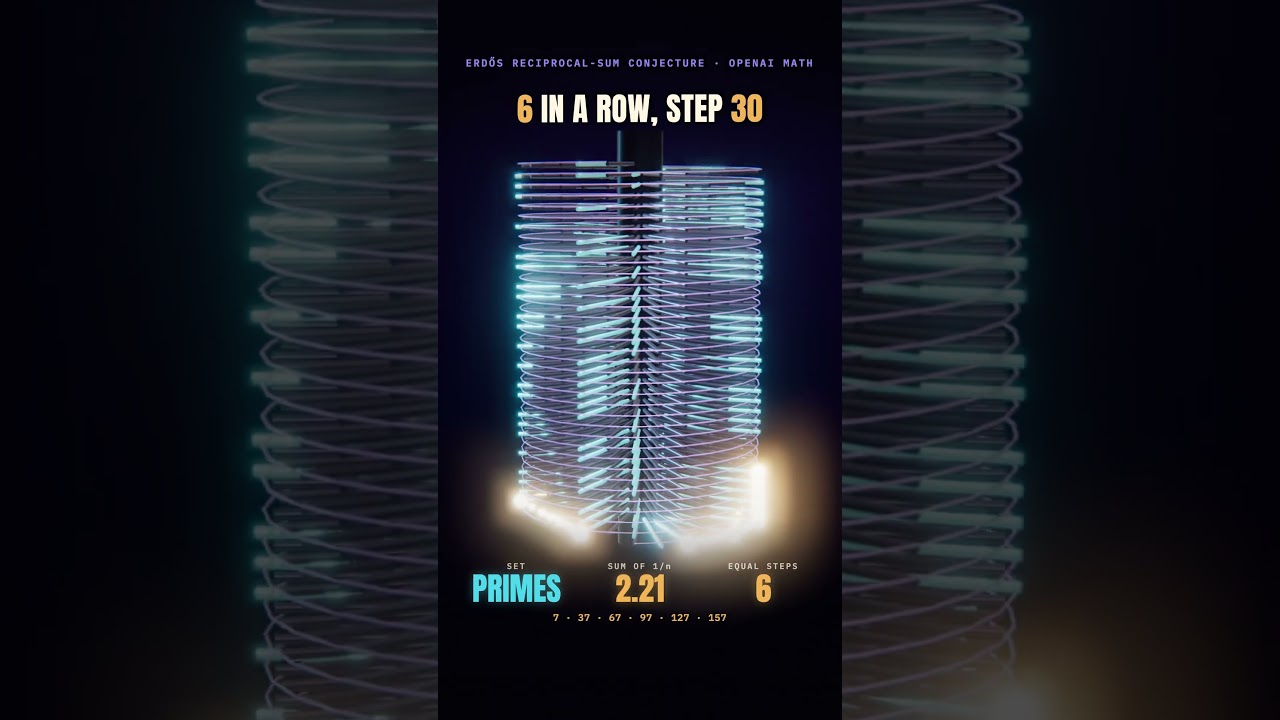
Ostmann's inverse Goldbach conjecture asks whether the primes can be built as a sumset A + B, every sum of one number from a set A and one from a set B, with both sets having at least two elements. OpenAI claims a proof that this is impossible, even if you are allowed to add or remove finitely many numbers from the primes first (an OpenAI preprint, not yet peer reviewed). The picture is a real computation: the numbers up to 600 wound on a helix with 30 per turn, and the largest possible B for A = {0, 2}, {0, 6} and {0, 30}; the primes that A + B misses (57, 24 and 14 of the 109) light up cyan, and the bar chart shows that no A = {0, a} with a up to 60 covers them all.
Paper (OpenAI, catalogue result 013):
- The additive indecomposability of the primes: github.com/openai/math/blob/main/preprints/the-additive-indec…
The animation illustrates the result; it is not a proof.
Gradient Damage: mathematics you can see, equations you can hear.
youtube.com/@gradientdamage
Every result explained: gradientdamage.com/p/013
About the problem
Number theory·OpenAI Math·Result 013
Ostmann’s inverse Goldbach conjecture
Proves that no finite modification of the primes can be written as A+B with A,B ⊆ ℤ≥ 0 each containing at least two elements. This resolves Ostmann's inverse Goldbach conjecture on additive indecomposability. (Lean)
Topics
Ostmann's inverse Goldbach conjectureinverse Goldbach problemOstmann conjectureGoldbachprime numbersprimessumsetadditive number theoryadditive decompositionadditive indecomposabilitytwin primesprime spiralnumber theoryOpenAIOpenAI mathAI mathematicsAI proofmathsmathematicsmath shorts3D animation