Short··0:20·Combinatorics
Hypercube Ramsey Conjecture: How Many Dots Force a Cube?
Watch on YouTubeAbout the problem →
About this video
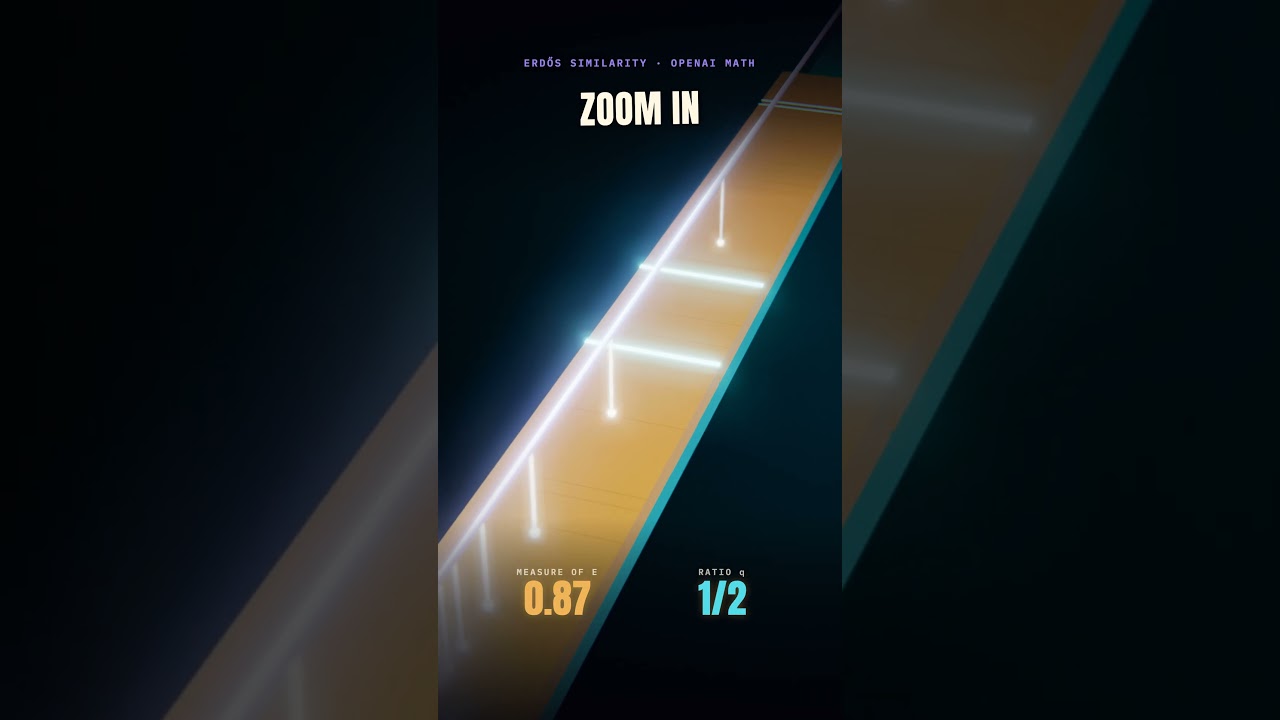
Colour every link between N dots gold or cyan: how large must N be before a one-colour copy of the n-dimensional cube is guaranteed? Burr and Erdős asked in 1975 whether this Ramsey number grows only linearly in the cube's 2^n corners, while the best bounds before stayed near (2^n)^2. OpenAI claims a proof that R(Q_n) ≤ C·2^n for an absolute constant C, resolving the hypercube Ramsey conjecture; this is OpenAI's preprint, not yet peer reviewed.
Paper (OpenAI, catalogue result 171):
- The hypercube Ramsey number has linear order: github.com/openai/math/blob/main/preprints/The-hypercube-Rams…
The animation illustrates the result; it is not a proof.
Gradient Damage: mathematics you can see, equations you can hear.
youtube.com/@gradientdamage
Every result explained: gradientdamage.com/p/171
About the problem
Combinatorics·OpenAI Math·Result 171
The hypercube Ramsey conjecture
Resolves the Burr–Erdős hypercube Ramsey conjecture: the two-color Ramsey number of the n-dimensional cube is Θ(2n). Thus every red-blue coloring of a complete graph on a universal constant times the cube's number of vertices contains a monochromatic copy of the cube.
Topics
hypercube Ramsey conjecturehypercube Ramsey numberRamsey number of the cubeBurr Erdős conjectureRamsey theoryRamsey numbershypercubetesseractn-dimensional cube4D cubegraph theoryextremal combinatoricstwo-colouringmonochromatic subgraphcombinatoricsOpenAIOpenAI mathAI mathematicsAI proofmathsmathematicsmath shorts3D animationBurr Erdos conjecture