Short··0:22·Number theory
Prime Factors of p−1: OpenAI Claims the Poisson–Dirichlet Law
Watch on YouTubeAbout the problem →
About this video
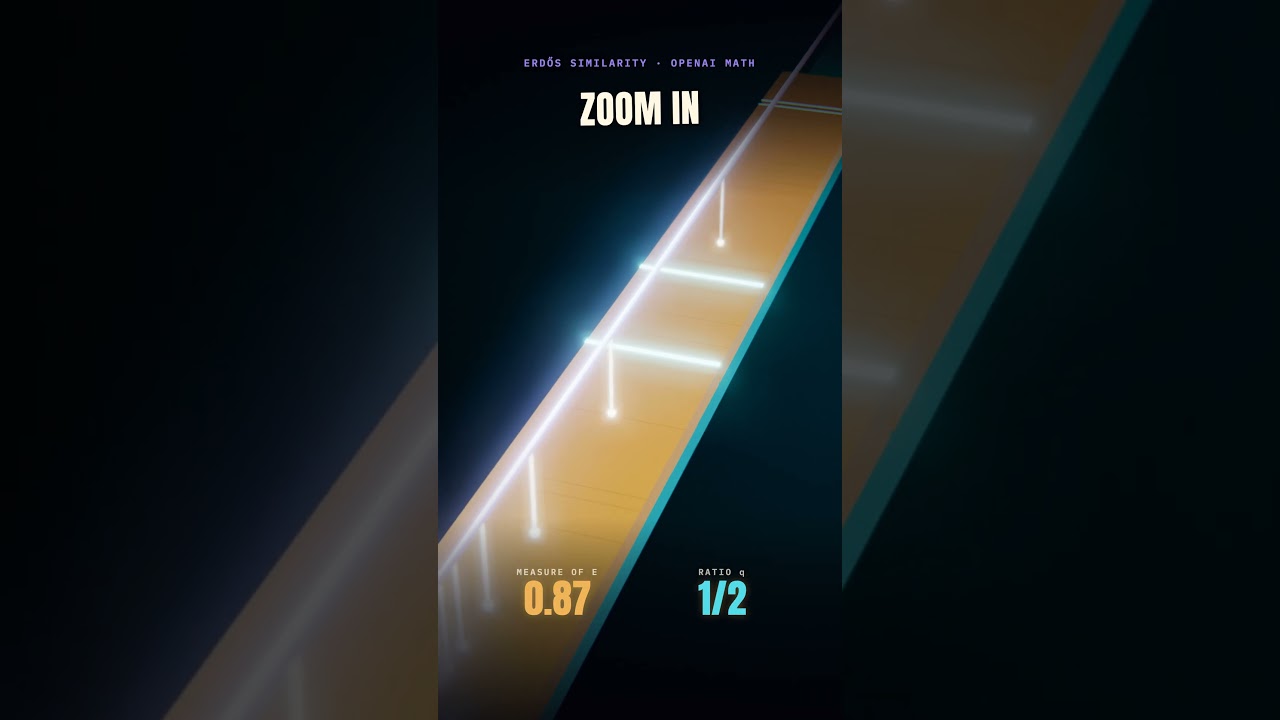
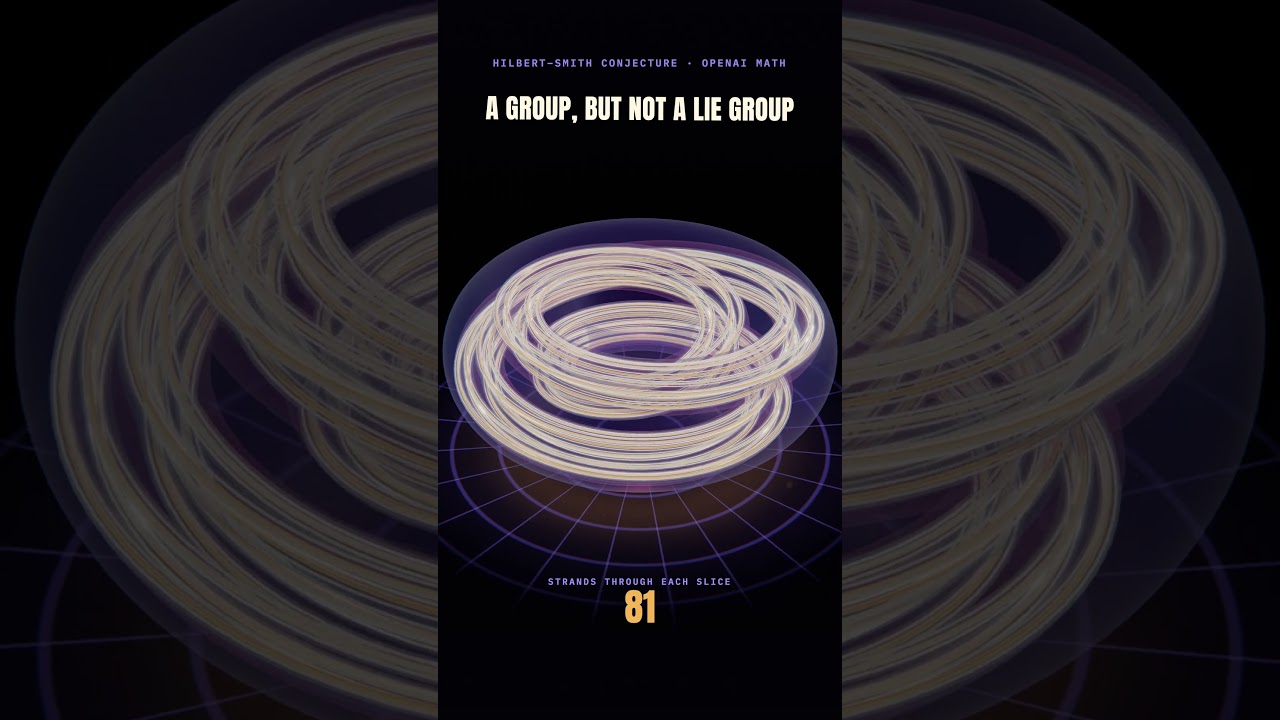
Take a random prime p, factor p−1, and measure each prime factor q by log q / log(p−1): the pieces always add up to 1. Ford, Konyagin and Luca conjectured that these pieces follow the Poisson–Dirichlet law PD(1), the same random stick-breaking that describes the prime factors of a typical integer; OpenAI claims a proof, plus Erdős's conjecture that infinitely many n have more than n^(1−ε) totient preimages and infinitely many primes with μ(p−1) = 1. These are OpenAI's preprints, not yet peer reviewed. Every column and every bar in the animation is computed from the real primes up to 10 million.
Papers (OpenAI, catalogue result 011):
- The Poisson-Dirichlet law for prime predecessors: github.com/openai/math/blob/main/preprints/The-Poisson-Dirich…
- Weighted dilation graphs, smooth shifted primes and totient fibers: github.com/openai/math/blob/main/preprints/Weighted-Dilation-…
- Prime Predecessors with an Even Number of Prime Factors: github.com/openai/math/blob/main/preprints/Prime-Predecessors…
The animation illustrates the result; it is not a proof.
Gradient Damage: mathematics you can see, equations you can hear.
youtube.com/@gradientdamage
Every result explained: gradientdamage.com/p/011
About the problem
Number theory·OpenAI Math·Result 011
Prime-factor statistics of p-1
Proves that the normalized ordered logarithms of the prime factors of p-1, counted with multiplicity, converge jointly to the Poisson–Dirichlet law PD(1) as p ranges uniformly over primes up to x and x → ∞. This resolves the Ford–Konyagin–Luca conjecture. It also proves that infinitely many integers n have more than n1-ε totient preimages, for every ε > 0.
Topics
prime factors of p-1shifted primesPoisson-Dirichlet distributionPoisson–Dirichlet lawFord Konyagin Luca conjectureDickman functionsmooth numberslargest prime factorEuler totient functiontotient preimagesErdős totient conjectureMöbius functionanalytic number theoryprime numbersnumber theoryOpenAIOpenAI mathAI mathematicsAI proofmathsmathematicsmath shortsPoisson-Dirichlet lawErdos totient conjectureMobius function