Short··0:21·Operator algebras
Kadison–Kaplansky Conjecture: OpenAI Claims a Counterexample
Watch on YouTubeAbout the problem →
About this video
The Kadison–Kaplansky conjecture says that if a group has no elements of finite order (it is torsion-free), the only projections in its reduced group C*-algebra, the elements with p² = p, are 0 and 1. The Baum–Connes conjecture is a deeper statement about the K-theory of the same algebras. OpenAI claims a finitely generated torsion-free group with a projection other than 0 and 1, a group with a projection of irrational trace that breaks coefficient-free reduced Baum–Connes, and a torsion-free group where Baum–Connes injectivity fails. These are OpenAI's claims and have not yet been peer reviewed.
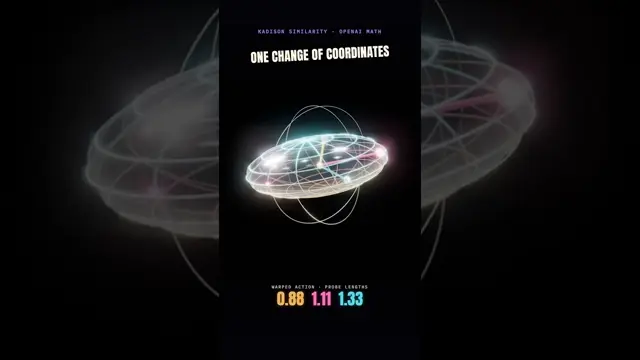
The pillars are group-algebra elements drawn on the group itself, height = coefficient. On the grid Z² a bump squares into 81 and then 289 terms: it spreads every time. On the loop Z/3, (1 + g + g²)/3 squares back to itself. The tall tower is the identity, 1. OpenAI's own groups are not drawn.
The animation illustrates the result; it is not a proof.
Papers:
- A torsion-free counterexample to the Kadison–Kaplansky projection conjecture: github.com/openai/math/blob/main/preprints/A-Torsion-Free-Cou…
- An irrational-trace counterexample to reduced Baum–Connes: github.com/openai/math/blob/main/preprints/An-Irrational-Trac…
- A torsion-free counterexample to reduced Baum–Connes injectivity: github.com/openai/math/blob/main/preprints/A-Torsion-Free-Cou…
Original visuals (three.js) and synthesized sound: every squaring is a chord that widens as the terms spread; each of the 9 products on the loop is a bell on the pillar it lands on.
Gradient Damage: mathematics you can see, equations you can hear.
youtube.com/@gradientdamage
Every result explained: gradientdamage.com/p/285
About the problem
Operator algebras·OpenAI Math·Result 285
Counterexamples to Baum–Connes and Kadison–Kaplansky
Disproves the coefficient-free reduced Baum–Connes conjecture through a failure of rational injectivity and a separate failure of surjectivity of assembly. A finitely generated torsion-free example witnesses the injectivity failure. Separately, a torsion-free group has a nontrivial projection in its reduced group C∗-algebra, disproving the Kadison–Kaplansky conjecture.
Topics
Kadison-Kaplansky conjectureKadison Kaplansky conjectureBaum-Connes conjectureBaum Connes conjecturecounterexampleprojectionidempotentgroup C*-algebrareduced group C*-algebratorsion-free groupoperator algebrasK-theoryassembly mapnoncommutative geometryKaplansky idempotent conjectureOpenAI mathAI proofAI mathematicsmath visualizationmaths shortsGradient Damage