Short··0:22·Operator algebras
Kadison's Similarity Problem: Every Warped Action Can Be Unwarped
Watch on YouTubeAbout the problem →
About this video
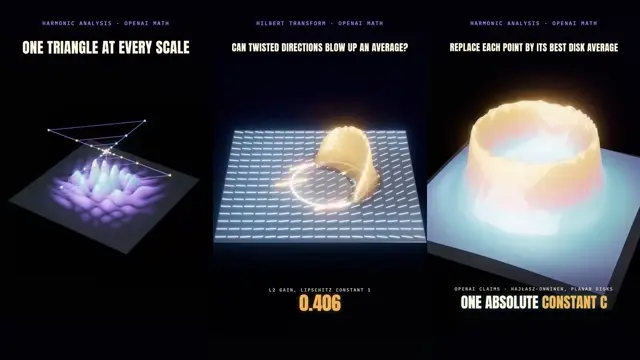
In 1955 Richard Kadison asked whether every bounded representation of a C*-algebra on a Hilbert space is similar to a *-representation: can one bounded, invertible change of coordinates S turn it into an action that keeps lengths, so that ρ = S π S⁻¹? OpenAI claims a proof that the answer is yes for every unital C*-algebra on every Hilbert space, along with one universal hyperreflexivity constant for all von Neumann algebras; this is OpenAI's preprint, not yet peer reviewed. The animation is a 3D cartoon: a rotation action seen through a stretch, then unwarped by one change of coordinates; the real problem lives in infinite dimensions.
Paper (OpenAI, catalogue result 288):
- Kadison's similarity theorem through uniform derivation estimates: github.com/openai/math/blob/main/preprints/Kadisons-similarit…
The animation illustrates the result; it is not a proof.
Gradient Damage: mathematics you can see, equations you can hear.
youtube.com/@gradientdamage
Every result explained: gradientdamage.com/p/288
About the problem
Operator algebras·OpenAI Math·Result 288
Kadison's similarity conjecture
Proves Kadison's similarity conjecture: every bounded complex-linear unital algebra homomorphism from a unital complex C∗-algebra to operators on a Hilbert space becomes a *-homomorphism after conjugation by a bounded invertible operator. (Lean)
Topics
Kadison similarity problemKadison's similarity conjectureKadison similarityC*-algebrasoperator algebrasHilbert spacebounded representation*-representationsimilarity problemvon Neumann algebrashyperreflexivityfunctional analysisRichard KadisonunitarizableOpenAIOpenAI mathAI mathematicsAI proofmathsmathematicsmath shorts3D animation