Compilation··29:20·Theoretical computer science
Every OpenAI Math Result, Part 3 of 4: Operator Paving, Naimark's Problem and 82 More
Watch on YouTubeAbout the problem →
About this video
Part 3 of 4: 84 results from OpenAI's public mathematics catalogue, one per chapter, in the order people search for them. Each chapter names the problem, shows the real objects, and states what OpenAI claims; none of it is peer reviewed yet. Every result has its own page: gradientdamage.com
Chapters:
0:00 Sakoda–Sipser Problem
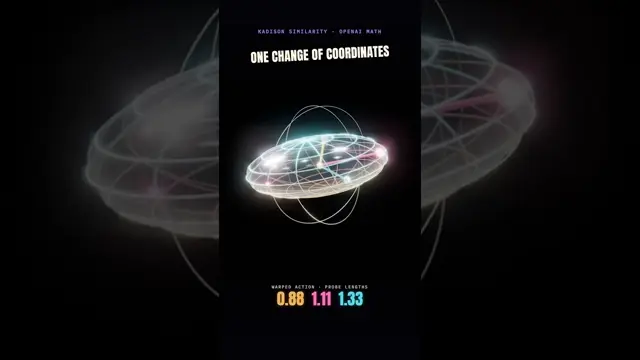
0:22 Strong Kadison–Kastler Stability
0:43 Toms–Winter Conjecture
1:05 Kirchberg's O2 Embedding Problem
1:26 Kaplansky's Quasitrace Conjecture
1:46 Generator Problem for von Neumann Algebras
2:07 Naimark's Problem
2:27 The Kirchberg–Rørdam Character Criterion
2:48 Operator Paving
3:08 Trace Cones Classify Razak–Jacelon Stabilizations
3:30 Kirchberg–Rørdam Question
3:51 4D Disk Embedding Conjecture
4:12 Purely Cosmetic Surgery Conjecture
4:33 Smith–Toda Complexes
4:55 Kervaire Invariant Problem at Prime 3
5:15 Quillen's Conjecture
5:36 Hovey–Strickland Conjecture
5:57 The Grothendieck Homotopy Hypothesis
6:17 K(n)-Local Sphere
6:39 Chromatic Fixed-Point Loss
7:00 The Singer Conjecture in Dimension Four
7:20 Curtis's Conjecture on the Hurewicz Image
7:41 Borel Conjecture in Dimension 4
8:02 Wall's D(2) Problem
8:24 Tingley's Problem
8:44 Separable Quotient Problem
9:05 Cotype–Cotype Conjecture
9:27 Metric Entropy Duality Conjecture
9:48 Kalton's Question
10:09 Ball's Extension Problem for L1
10:29 Gromov's Scalar Curvature Bound for Simplicial Volume
10:50 The Cartan–Hadamard Conjecture
11:10 Yau's Uniformization Conjecture
11:31 Katok's Entropy Rigidity Conjecture
11:51 Nearby Lagrangian Conjecture
12:13 Donaldson's Hypersymplectic Conjecture
12:34 Donaldson's Tamed-to-Compatible Conjecture
12:56 Blaschke Conjecture
13:17 Singular Sets of Varifolds
13:38 Strong Arnold Conjecture
13:58 Nonnegatively Curved Einstein 4-Manifolds
14:20 The Solomon–Yau Least-Volume Conjecture
14:40 Scalar Curvature and Ricci Flow Singularities
15:01 Calabi Flow
15:21 Affine Bernstein Problem
15:42 Gigli's Conjecture on Alexandrov Curvature
16:03 Bi-Lipschitz Coordinates at Regular RCD Points
16:23 A 3-Manifold With No Conjugate Points but No Nonpositive Curvature
16:44 Yau's Harmonic Function Question
17:05 Boltzmann Equation
17:27 The Mumford-Shah Conjecture in the Plane
17:48 One-Phase Bernoulli Problem
18:09 The Ball–Evans Approximation Problem in 3D
18:29 Hot Spots Conjecture
18:51 The Hénon–Lane–Emden Conjecture
19:11 Coulomb Monge Problem
19:32 Sharp One-Third Stability of Brenier Maps
19:52 Infinity-Harmonic Functions
20:14 Erdős–Pomerance Conjecture
20:35 The Irrationality Exponent of π Is 2
20:56 Number of Totients
21:16 Short Egyptian Fractions
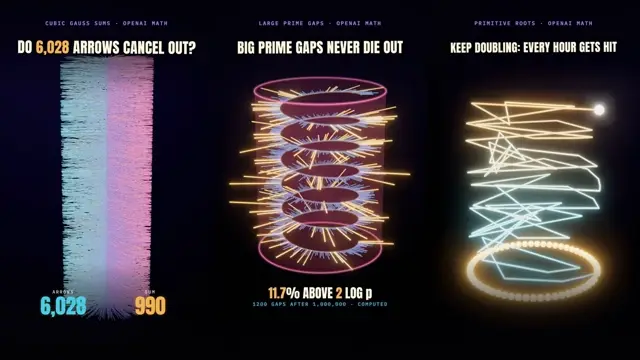
21:38 Large Prime Gaps Have Positive Density
21:59 Integral Points on Character Varieties of Curves
22:20 Artin's Primitive Root Conjecture
22:41 Modularity Over Imaginary Quadratic Fields
23:01 Iitaka's Subadditivity Conjecture
23:21 Log Abundance for Kähler Spaces
23:43 Numerical Semiampleness and Minimal Models
24:04 Every K3 Surface Is Oka
24:26 Shafarevich Conjecture
24:47 Zariski's Cancellation Problem
25:08 Beauville's Splitting Conjecture
25:29 Pixton's Completeness Conjecture
25:51 Termination of Flips in Dimension 4
26:12 Campana's Abelianity Conjecture
26:32 The Kollár–Pardon Conjecture
26:52 Bounded Klt Complements for Fano Contractions
27:13 Anticanonical Nonvanishing in Every Dimension
27:33 Turyn's Merit Factor Conjecture
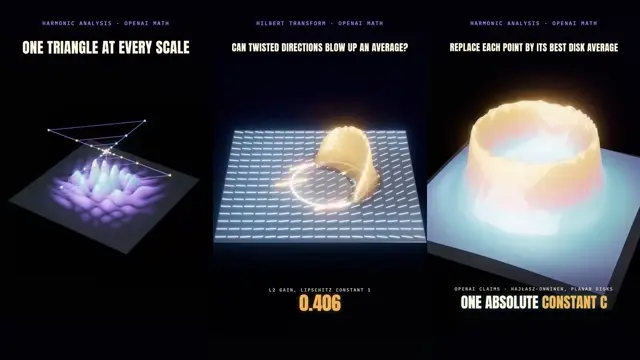
27:55 Fourier Restriction Conjecture in 3D
28:16 Local Smoothing in Three Dimensions
28:37 Carleson's Schrödinger Problem at the Endpoint
28:58 Riesz Transforms and Rectifiability
The animations illustrate the results; they are not proofs.
Gradient Damage: mathematics you can see, equations you can hear.
youtube.com/@gradientdamage
Chapters
One problem per chapter. Each name links to the result's own page, each time to that moment on YouTube.
- Sakoda–Sipser Problem Theoretical computer science
- Strong Kadison–Kastler Stability Operator algebras
- Toms–Winter Conjecture Operator algebras
- Kirchberg's O2 Embedding Problem Operator algebras
- Kaplansky's Quasitrace Conjecture Operator algebras
- Generator Problem for von Neumann Algebras Operator algebras
- Naimark's Problem Operator algebras
- The Kirchberg–Rørdam Character Criterion Operator algebras
- Operator Paving Operator algebras
- Trace Cones Classify Razak–Jacelon Stabilizations Operator algebras
- Kirchberg–Rørdam Question Operator algebras
- 4D Disk Embedding Conjecture Topology
- Purely Cosmetic Surgery Conjecture Topology
- Smith–Toda Complexes Topology
- Kervaire Invariant Problem at Prime 3 Topology
- Quillen's Conjecture Topology
- Hovey–Strickland Conjecture Topology
- The Grothendieck Homotopy Hypothesis Topology
- K(n)-Local Sphere Topology
- Chromatic Fixed-Point Loss Topology
- The Singer Conjecture in Dimension Four Topology
- Curtis's Conjecture on the Hurewicz Image Topology
- Borel Conjecture in Dimension 4 Topology
- Wall's D(2) Problem Topology
- Tingley's Problem Functional analysis
- Separable Quotient Problem Functional analysis
- Cotype–Cotype Conjecture Functional analysis
- Metric Entropy Duality Conjecture Functional analysis
- Kalton's Question Functional analysis
- Ball's Extension Problem for L1 Functional analysis
- Gromov's Scalar Curvature Bound for Simplicial Volume Differential geometry
- The Cartan–Hadamard Conjecture Differential geometry
- Yau's Uniformization Conjecture Differential geometry
- Katok's Entropy Rigidity Conjecture Differential geometry
- Nearby Lagrangian Conjecture Differential geometry
- Donaldson's Hypersymplectic Conjecture Differential geometry
- Donaldson's Tamed-to-Compatible Conjecture Differential geometry
- Blaschke Conjecture Differential geometry
- Singular Sets of Varifolds Differential geometry
- Strong Arnold Conjecture Differential geometry
- Nonnegatively Curved Einstein 4-Manifolds Differential geometry
- The Solomon–Yau Least-Volume Conjecture Differential geometry
- Scalar Curvature and Ricci Flow Singularities Differential geometry
- Calabi Flow Differential geometry
- Affine Bernstein Problem Differential geometry
- Gigli's Conjecture on Alexandrov Curvature Differential geometry
- Bi-Lipschitz Coordinates at Regular RCD Points Differential geometry
- A 3-Manifold With No Conjugate Points but No Nonpositive Curvature Differential geometry
- Yau's Harmonic Function Question Differential geometry
- Boltzmann Equation Partial differential equations
- The Mumford-Shah Conjecture in the Plane Partial differential equations
- One-Phase Bernoulli Problem Partial differential equations
- The Ball–Evans Approximation Problem in 3D Partial differential equations
- Hot Spots Conjecture Partial differential equations
- The Hénon–Lane–Emden Conjecture Partial differential equations
- Coulomb Monge Problem Partial differential equations
- Sharp One-Third Stability of Brenier Maps Partial differential equations
- Infinity-Harmonic Functions Partial differential equations
- Erdős–Pomerance Conjecture Number theory
- The Irrationality Exponent of π Is 2 Number theory
- Number of Totients Number theory
- Short Egyptian Fractions Number theory
- Large Prime Gaps Have Positive Density Number theory
- Integral Points on Character Varieties of Curves Number theory
- Artin's Primitive Root Conjecture Number theory
- Modularity Over Imaginary Quadratic Fields Number theory
- Iitaka's Subadditivity Conjecture Algebraic and complex geometry
- Log Abundance for Kähler Spaces Algebraic and complex geometry
- Numerical Semiampleness and Minimal Models Algebraic and complex geometry
- Every K3 Surface Is Oka Algebraic and complex geometry
- Shafarevich Conjecture Algebraic and complex geometry
- Zariski's Cancellation Problem Algebraic and complex geometry
- Beauville's Splitting Conjecture Algebraic and complex geometry
- Pixton's Completeness Conjecture Algebraic and complex geometry
- Termination of Flips in Dimension 4 Algebraic and complex geometry
- Campana's Abelianity Conjecture Algebraic and complex geometry
- The Kollár–Pardon Conjecture Algebraic and complex geometry
- Bounded Klt Complements for Fano Contractions Algebraic and complex geometry
- Anticanonical Nonvanishing in Every Dimension Algebraic and complex geometry
- Turyn's Merit Factor Conjecture Real and complex analysis
- Fourier Restriction Conjecture in 3D Real and complex analysis
- Local Smoothing in Three Dimensions Real and complex analysis
- Carleson's Schrödinger Problem at the Endpoint Real and complex analysis
- Riesz Transforms and Rectifiability Real and complex analysis
Chapter 1: about the problem
Theoretical computer science·OpenAI Math·Result 129
Exponential state costs for two-way automata
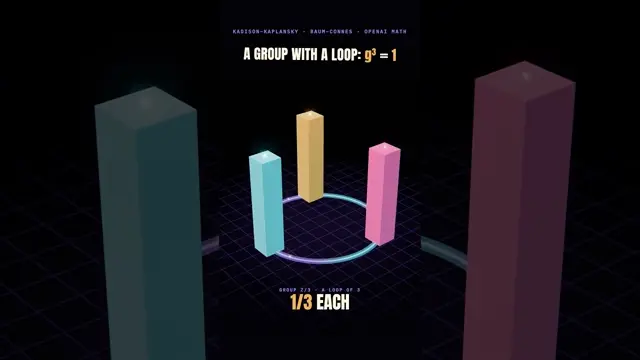
Proves exponential lower bounds both for complementing two-way nondeterministic finite automata and for simulating one-way nondeterministic automata by two-way deterministic ones. The latter resolves the Sakoda–Sipser state-succinctness conjecture over growing finite alphabets; both results rule out polynomial state bounds independent of alphabet size. (Lean)
Chapter 2: about the problem
Operator algebras·OpenAI Math·Result 289·from 0:22
Strong Kadison–Kastler stability and its spatial boundaries
Proves that sufficiently close unital von Neumann algebras on the same Hilbert space are conjugate by a unitary arbitrarily close to the identity, with a universal tolerance in the operator-norm distance between unit balls. Counterexamples show that near-identity conjugacy fails for one-sided near inclusions, and that arbitrarily close norm-separable C∗-algebras need not be ambiently unitarily conjugate. (Lean)
Chapter 3: about the problem
Operator algebras·OpenAI Math·Result 291·from 0:43
Cuntz comparison, nuclear dimension, and equivariant Jiang–Su stability
Proves equivariant Jiang–Su stability for every countable discrete amenable group action on a simple separable unital infinite-dimensional nuclear stably finite Jiang–Su-stable C∗-algebra, resolving this case of Szabó's conjecture without restrictions on trace dynamics. The family also proves the unital Toms–Winter conjecture, equating strict comparison, finite nuclear dimension and Jiang–Su stability in the simple separable unital infinite-dimensional nuclear setting. (Lean)
Chapter 4: about the problem
Operator algebras·OpenAI Math·Result 292·from 1:05
Kirchberg's 𝒪2 norm-ultrapower embedding problem
Constructs an explicit separable unital full group C∗-algebra that cannot embed unitally into the norm ultrapower of any fixed nonzero unital nuclear C∗-algebra, for any free ultrafilter on the natural numbers. Taking the target to be 𝒪2 answers Kirchberg's norm-ultrapower embedding problem negatively. (Lean)
Chapter 5: about the problem
Operator algebras·OpenAI Math·Result 294·from 1:26
Kaplansky's quasitrace conjecture and failure of tensor-product stable finiteness
Disproves Kaplansky's quasitrace conjecture by constructing a separable unital complex C∗-algebra admitting normalized 2-quasitraces, all of which are nonadditive. As a consequence, two unital simple stably finite C∗-algebras can have a properly infinite minimal tensor product, with one factor Cr*(𝔽2). (Lean)
Chapter 6: about the problem
Operator algebras·OpenAI Math·Result 296·from 1:46
The generator problem for finite factors
Proves that every type II1 factor with separable predual is generated by a single operator, equivalently by two self-adjoint operators, resolving the generator problem. More strongly, for every irreducible inclusion P ⊂ M of such factors, the unitaries u with M=W*(P,u) form a dense Gδ subset in the trace 2-norm topology. (Lean)
Chapter 7: about the problem
Operator algebras·OpenAI Math·Result 297·from 2:07
A ZFC counterexample to Naimark's problem
Gives an alternative to Tanaka's ZFC construction of a unital infinite-dimensional simple complex C∗-algebra with a faithful tracial state and exactly one nonzero irreducible representation up to unitary equivalence. Thus the unrestricted compact-operator characterization fails without additional set-theoretic assumptions; the counterexample is nonseparable. (Lean)
Chapter 8: about the problem
Operator algebras·OpenAI Math·Result 299·from 2:27
The Kirchberg–Rørdam character criterion and infinite tensor-power Jiang–Su stability
A nonzero unital separable complex C∗-algebra is Jiang–Su stable exactly when its norm central-sequence algebra has no characters, for every free ultrafilter. This answers the Kirchberg–Rørdam character question. Also, the infinite minimal tensor power of every such algebra without characters is Jiang–Su stable, answering the Dadarlat–Toms question. (Lean)
Chapter 9: about the problem
Operator algebras·OpenAI Math·Result 300·from 2:48
Approximation and quadratic strong-operator paving
Proves that every self-adjoint element of a complex von Neumann algebra admits strong-operator paving relative to any maximal abelian subalgebra with O(ε-2) blocks. The norm bound holds after compression by a projection arbitrarily close to the identity in the strong topology, resolving the Popa–Vaes quadratic paving conjecture.
Chapter 10: about the problem
Operator algebras·OpenAI Math·Result 301·from 3:08
Trace cones and Razak–Jacelon stabilization
Classifies separable nuclear complex C∗-algebras after tensoring with the Razak–Jacelon algebra and the compact operators, using their full topological cones of extended lower-semicontinuous tracial weights. This answers Robert’s trace-cone question, including algebras with arbitrary ideal structure and both finite and infinite subquotients. (Lean)
Chapter 11: about the problem
Operator algebras·OpenAI Math·Result 303·from 3:30
Weak pure infiniteness and Cuntz-algebra absorption
Resolves the ordinary-to-strong pure-infiniteness question of Kirchberg and Rørdam for complex C∗-algebras. For exact algebras, proper infiniteness of one fixed finite amplification of every positive element also suffices. Consequently, every separable nuclear algebra with this property absorbs 𝒪∞, without unitality or simplicity assumptions. (Lean)
Chapter 12: about the problem
Topology·OpenAI Math·Result 305·from 3:51
Four-dimensional disk embedding and Wall's conjecture
The unrestricted four-dimensional disk-embedding conjecture fails: framed algebraic dual spheres do not suffice to obtain disjoint locally flat spanning disks. In particular, the free group F2 is not good in the sense of Freedman–Quinn. Also constructs a finitely presented integral Poincaré duality group of dimension four with a finite classifying space but no realization as the fundamental group of a closed aspherical topological four-manifold, disproving Wall's conjecture.
Chapter 13: about the problem
Topology·OpenAI Math·Result 306·from 4:12
The purely cosmetic surgery conjecture
Distinct Dehn surgery slopes on a nontrivial smooth knot in S3 never produce orientation-preservingly homeomorphic manifolds, proving the purely cosmetic surgery conjecture. The statement includes the meridional slope.
Chapter 14: about the problem
Topology·OpenAI Math·Result 308·from 4:33
Finite Smith–Toda complexes at every height
For every n ≥ 0, constructs a finite Smith–Toda spectrum at a prime p depending on n, with Brown–Peterson homology BP*/(p,v1,…,vn) and the canonical comodule structure. Thus Smith–Toda complexes exist at every height when the prime may vary; an explicit example realizes V(4) at p = 1009.
Chapter 15: about the problem
Topology·OpenAI Math·Result 309·from 4:55
The Kervaire invariant problem at the prime three
Resolves the odd-primary Kervaire invariant problem at the prime three: exactly the standard classes with indices 0, 2, and 3 survive in the mod-three Adams spectral sequence, in stems 10, 106, and 322. Each surviving detection coset contains an element of exact additive order three.
Chapter 16: about the problem
Topology·OpenAI Math·Result 310·from 5:15
Quillen's conjecture in rational homology
Proves the rational-homology form of Quillen's conjecture for every finite group and every prime. If the largest normal p-subgroup of G is trivial, the poset of nontrivial elementary abelian p-subgroups has nonzero augmented reduced rational homology and is therefore not contractible.
Chapter 17: about the problem
Topology·OpenAI Math·Result 311·from 5:36
The Hovey–Strickland and Chai conjectures
Proves Chai's invariant-ideal conjecture for Lubin–Tate deformation rings over finite residue fields, at every prime and positive height n. Through the implication of Barthel–Heard–Naumann, this proves the Hovey–Strickland conjecture: dualizable K(n)-local spectra have exactly n+2 thick tensor ideals, and their Balmer spectrum is a chain of n+1 points.
Chapter 18: about the problem
Topology·OpenAI Math·Result 312·from 5:57
The Grothendieck homotopy hypothesis
Proves the Grothendieck homotopy hypothesis for ∞-groupoids associated with every Grothendieck coherator in the Ara–Henry convention: these algebraic objects recover the homotopy theory of spaces. (Lean)
Chapter 19: about the problem
Topology·OpenAI Math·Result 313·from 6:17
Finite generation for the K(n)-local sphere
Answers the degreewise finiteness question of Hovey and Hovey–Strickland: every homotopy group of the K(n)-local sphere is a finitely generated ℤp-module, for every prime, positive height and integer degree. The same conclusion holds after K(n)-localizing any finite p-local spectrum.
Chapter 20: about the problem
Topology·OpenAI Math·Result 314·from 6:39
Cyclic length and chromatic fixed-point loss
Determines the optimal chromatic loss from geometric H-fixed points to geometric G-fixed points for every subgroup H of a finite p-group G. At every nonnegative height, the loss equals the shortest subnormal-chain length from H to G with cyclic quotients. Each quotient counts once regardless of order, and finite spectra witness sharpness.
Chapter 21: about the problem
Topology·OpenAI Math·Result 315·from 7:00
The four-dimensional Singer conjecture
Proves that the L2-Betti numbers of the universal cover of every closed connected aspherical topological four-manifold vanish outside degree two. More generally, the same conclusion holds for every finite connected aspherical integral Poincaré complex of formal dimension four, proving the four-dimensional Singer conjecture in this wider class.
Chapter 22: about the problem
Topology·OpenAI Math·Result 316·from 7:20
Curtis’s conjecture
Proves Curtis’s conjecture: the positive-degree mod-two stable Hurewicz image of the sphere is spanned by the images of the Hopf-invariant-one classes η, ν, σ and the Kervaire-invariant-one classes that exist.
Chapter 23: about the problem
Topology·OpenAI Math·Result 320·from 7:41
Nonhomeomorphic closed aspherical four-manifolds
Constructs closed connected aspherical topological four-manifolds that are homotopy equivalent but not homeomorphic, with a common word-hyperbolic fundamental group. This disproves even the homeomorphism-existence formulation of the Borel conjecture in dimension four.
Chapter 24: about the problem
Topology·OpenAI Math·Result 321·from 8:02
A counterexample to Wall's finite D(2) problem
Constructs a finite connected three-dimensional CW complex whose universal cover has no integral homology above degree two and whose third cohomology vanishes for every local coefficient module, but which has no finite two-dimensional homotopy model. This disproves Wall's finite D(2) conjecture; the example has infinite fundamental group.
Chapter 25: about the problem
Functional analysis·OpenAI Math·Result 322·from 8:24
Tingley’s sphere-isometry problem
Resolves Tingley's problem: every surjective isometry between the unit spheres of nonzero real Banach spaces extends uniquely to a surjective real-linear isometry of the whole spaces. No dimension restriction is imposed, so the metric geometry of the unit sphere determines the Banach space up to linear isometry. (Lean)
Chapter 26: about the problem
Functional analysis·OpenAI Math·Result 323·from 8:44
Independence of the separable quotient problem
Establishes, relative to the consistency of a measurable cardinal, that the separable quotient problem is independent of ZFC. The assertion that every infinite-dimensional Banach space has a separable infinite-dimensional quotient can hold for all real and complex Banach spaces, whereas the continuum hypothesis yields counterexamples over both fields. (Lean)
Chapter 27: about the problem
Functional analysis·OpenAI Math·Result 326·from 9:05
The cotype–cotype conjecture under the approximation property
Resolves the cotype–cotype conjecture for real Banach spaces with the approximation property. Such a nonzero space is K-convex if and only if both it and its dual have finite Rademacher cotype, with possibly different exponents. Equivalently, these cotype assumptions force nontrivial Rademacher type. (Lean)
Chapter 28: about the problem
Functional analysis·OpenAI Math·Result 329·from 9:27
A counterexample to metric-entropy duality
Disproves Pietsch's dimension-free duality conjecture for metric entropy. Origin-symmetric convex bodies violate every proposed choice of universal constants in the conjectured comparison between covering numbers and those of the polar bodies, even when the covering body is a cube. (Lean)
Chapter 29: about the problem
Functional analysis·OpenAI Math·Result 330·from 9:48
A uniformly discrete counterexample to bounded approximation in Lipschitz-free spaces
Constructs a countable uniformly discrete metric space whose real Lipschitz-free Banach space has the approximation property but not the bounded approximation property, answering Kalton's question negatively. Finite-rank operators approximate the identity on every compact set, but their norms cannot share a finite bound. (Lean)
Chapter 30: about the problem
Functional analysis·OpenAI Math·Result 332·from 10:09
Metric Markov cotype of ℓ1 and Hilbert-space Lipschitz extension
Proves that real ℓ1 has metric Markov cotype two, answering Mendel and Naor's question. Consequently, every Lipschitz map from an arbitrary subset of a real Hilbert space into ℓ1 extends to the whole space with a universal multiplicative loss in its Lipschitz constant, resolving Ball's extension problem for this target.
Chapter 31: about the problem
Differential geometry·OpenAI Math·Result 335·from 10:29
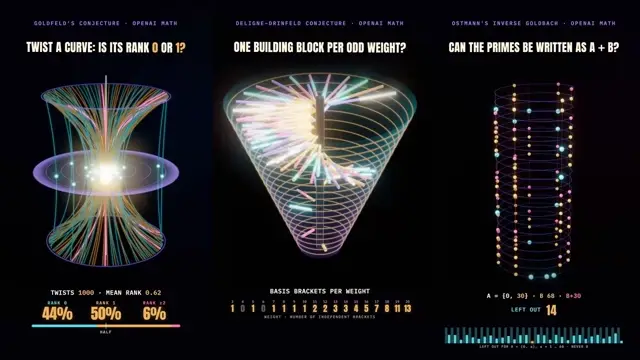
Gromov’s integral scalar-curvature bound for simplicial volume
Proves ∫M(Scalg-)n/2 dVg ≥ an‖ M‖ for every closed connected oriented smooth n-manifold, n ≥ 3, and every smooth metric, with an > 0 depending only on dimension. Here Scalg-=max {0,-Scalg} and ‖ M‖ is real simplicial volume. Also proves rational inessentiality under positive scalar curvature, resolving the Gromov–Lawson conjecture; every nonnegative-scalar-curvature metric on a closed aspherical manifold is flat.
Chapter 32: about the problem
Differential geometry·OpenAI Math·Result 337·from 10:50
Sharp Cartan–Hadamard isoperimetry and rigidity
Proves generalized Cartan–Hadamard isoperimetry in every dimension: in a complete simply connected manifold with sectional curvature at most κ ≤ 0, every finite-volume finite-perimeter set satisfies the sharp comparison with the equal-volume model ball. Bounded positive-volume equality regions for κ = 0 are Euclidean balls. Also proves sharp Euclidean filling bounds for compactly supported integral n-cycles, n ≥ 2, in arbitrary proper CAT(0) spaces. (Lean)
Chapter 33: about the problem
Differential geometry·OpenAI Math·Result 338·from 11:10
Yau's uniformization conjecture
Proves Yau's uniformization conjecture: every complete connected noncompact Kähler manifold with strictly positive holomorphic bisectional curvature is biholomorphic to ℂn.
Chapter 34: about the problem
Differential geometry·OpenAI Math·Result 339·from 11:31
Katok's entropy rigidity conjecture
Proves Katok's entropy rigidity conjecture for closed connected Riemannian manifolds of dimension at least three with strictly negative sectional curvature: normalized Liouville measure maximizes entropy for the geodesic flow if and only if the metric is locally symmetric.
Chapter 35: about the problem
Differential geometry·OpenAI Math·Result 340·from 11:51
A counterexample to the nearby Lagrangian conjecture
Disproves the unrestricted nearby Lagrangian conjecture. For some sufficiently large even N, constructs a closed exact embedded Lagrangian in T*(S9× SN-1) that is diffeomorphic to the base but not Hamiltonian isotopic to its zero section.
Chapter 36: about the problem
Differential geometry·OpenAI Math·Result 341·from 12:13
Donaldson's hypersymplectic deformation conjecture
Proves Donaldson's hypersymplectic deformation conjecture in a cohomology-preserving form. Every positive triple of smooth closed two-forms on a closed connected oriented four-manifold, normalized by ∫ωi∧ωj=δij, deforms through positive closed triples to a hyperkähler triple while preserving all three cohomology classes. Any positive triple can first be normalized by a constant linear change.
Chapter 37: about the problem
Differential geometry·OpenAI Math·Result 342·from 12:34
Donaldson's tamed-to-compatible conjecture
Proves Donaldson's tamed-to-compatible conjecture: every smooth almost complex structure on a closed four-manifold that is tamed by a symplectic form admits a compatible symplectic form. The almost complex structure stays fixed; the form's cohomology class may change. (Lean)
Chapter 38: about the problem
Differential geometry·OpenAI Math·Result 344·from 12:56
The metric Blaschke conjecture
Proves the metric Blaschke conjecture: every closed connected Riemannian manifold of positive dimension whose injectivity radius equals its diameter is, up to scaling, a standard compact rank-one symmetric space.
Chapter 39: about the problem
Differential geometry·OpenAI Math·Result 346·from 13:17
Sharp singular-set bounds for stationary integral varifolds
Proves that every stationary integral m-varifold in a Euclidean open set has singular set of Hausdorff dimension at most m-1, a sharp bound in every positive dimension and codimension. On round spheres, the family also proves almost-everywhere regularity: the singular set has zero m-dimensional Hausdorff measure.
Chapter 40: about the problem
Differential geometry·OpenAI Math·Result 347·from 13:38
Counterexamples to stable-Morse and strong Arnold fixed-point bounds
Disproves stable-Morse lower bounds for nondegenerate Hamiltonian fixed points: on simply connected closed Kähler manifolds of real dimension 22, the deficit below the stable Morse number is unbounded. A separate Hamiltonian diffeomorphism of the complex quadric threefold has exactly three fixed points, fewer than the four critical points required of every smooth function. (Lean)
Chapter 41: about the problem
Differential geometry·OpenAI Math·Result 348·from 13:58
Nonnegative-curvature Einstein classification and an L2 topological gap
Classifies closed connected Einstein four-manifolds with positive Einstein constant and nonnegative sectional curvature: up to scaling, their universal Riemannian covers are the round S4, Fubini–Study ℂℙ2, or a product of equal round two-spheres. A closed simply connected nonnegatively curved four-manifold is diffeomorphic to one of these whenever the scale-invariant L2 norm of its trace-free Ricci curvature lies below a universal positive constant. (Lean)
Chapter 42: about the problem
Differential geometry·OpenAI Math·Result 349·from 14:20
The Solomon–Yau least-volume conjecture
Proves the Solomon–Yau least-volume conjecture for minimal hypersurfaces of round spheres. For every m ≥ 2, a closed connected minimal immersion into the unit sphere Sm+1 with non-totally-geodesic image has volume at least that of the smallest minimal Clifford product, counting covering multiplicity.
Chapter 43: about the problem
Differential geometry·OpenAI Math·Result 351·from 14:40
Scalar curvature and finite-time Ricci-flow singularities
Proves that a smooth Ricci flow on a closed four-manifold extends past any finite time at which scalar curvature remains uniformly bounded. A higher-dimensional counterexample has bounded scalar curvature but unbounded full curvature at its finite maximal time, disproving the unrestricted scalar-curvature extension conjecture.
Chapter 44: about the problem
Differential geometry·OpenAI Math·Result 352·from 15:01
A finite-time singularity of Calabi flow
Disproves Chen's smooth long-time existence conjecture for Calabi flow by constructing a smooth U(10)-invariant Kähler metric on ℂℙ10 whose flow develops a finite-time singularity. The metric lies in the Fubini–Study class, so the failure occurs even in a class containing a constant-scalar-curvature metric.
Chapter 45: about the problem
Differential geometry·OpenAI Math·Result 353·from 15:21
Affine Bernstein rigidity through dimension nine and a smooth dimension-ten counterexample
Proves that every smooth locally uniformly convex affine-maximal graph of dimension three through nine, complete for its induced Euclidean metric, is an elliptic paraboloid. A smooth entire nonquadratic example in dimension ten makes this range sharp. In dimensions three through nine, the paraboloid classification also holds for connected open locally uniformly convex affine-maximal hypersurfaces complete for the affine Berwald–Blaschke metric. (Lean)
Chapter 46: about the problem
Differential geometry·OpenAI Math·Result 356·from 15:42
Gigli’s characterization of Alexandrov curvature
Proves Gigli's conjecture: in every integer dimension n ≥ 2, Alexandrov curvature at least κ is characterized by the full-support RCD ((n-1)κ,n) condition with reference measure ℋn and distributional sectional curvature at least κ in the original global test classes. The RCD condition is unreduced. (Lean)
Chapter 47: about the problem
Differential geometry·OpenAI Math·Result 357·from 16:03
Bi-Lipschitz coordinates at every regular RCD point
Proves that every regular point of a noncollapsed RCD (K,n) space, for K ∈ ℝ and integer n ≥ 2, has an open neighborhood bi-Lipschitz to an open subset of ℝn. Regularity requires all pointed tangents to be Euclidean, the reference measure is exactly ℋn, and the chart compares ambient distances with a point-dependent finite constant.
Chapter 48: about the problem
Differential geometry·OpenAI Math·Result 358·from 16:23
A three-manifold without conjugate points or nonpositive curvature
Constructs a closed connected orientable smooth three-manifold that admits a metric without conjugate points but no metric of nonpositive sectional curvature. This answers negatively, already in dimension three, whether the first metric-existence property implies the second. (Lean)
Chapter 49: about the problem
Differential geometry·OpenAI Math·Result 361·from 16:44
Failure of integer-degree harmonic dimension comparison
Disproves Yau's proposed Euclidean dimension bound for harmonic functions of integer growth on manifolds with nonnegative Ricci curvature. For every sufficiently large integer k, a complete smooth metric on ℝ3 has at least (k+2)2 independent harmonic functions of growth at most k, exceeding the Euclidean count (k+1)2. The metric may depend on k. (Lean)
Chapter 50: about the problem
Partial differential equations·OpenAI Math·Result 363·from 17:05
Nonuniqueness with local conservation for the hard-sphere Boltzmann equation
Constructs two distinct global entropy solutions of the three-dimensional periodic hard-sphere Boltzmann equation from the same nonnegative initial density, with bounded velocity support and finite mass, energy and absolute entropy. Both are strongly continuous in L1 and satisfy exact local conservation of mass, momentum and kinetic energy. (Lean)
Chapter 51: about the problem
Partial differential equations·OpenAI Math·Result 366·from 17:27
The planar Mumford–Shah regularity conjecture and local weak-L4 gradient bounds
Resolves the interior regularity conjecture for reduced absolute planar Mumford–Shah minimizers with bounded fidelity data. Locally, the closed discontinuity set is a C1,α arc, a regular crack tip, or three arcs meeting at 120°; only finitely many global connected components meet any compact interior region.
Chapter 52: about the problem
Partial differential equations·OpenAI Math·Result 367·from 17:48
The critical dimension for the one-phase Bernoulli problem
Establishes seven as the first dimension admitting a nonflat, one-homogeneous global minimizer of the one-phase Bernoulli energy. Consequently, minimizing free boundaries are smooth through dimension six, and their singular sets have dimension at most n-7 in higher dimensions. (Lean)
Chapter 53: about the problem
Partial differential equations·OpenAI Math·Result 368·from 18:09
The three-dimensional Ball–Evans approximation problem
Resolves the three-dimensional Ball–Evans approximation problem: every W1,p homeomorphism between arbitrary bounded domains in ℝ3, for 1 ≤ p < ∞, is a strong W1,p limit of smooth diffeomorphisms onto the same target.
Chapter 54: about the problem
Partial differential equations·OpenAI Math·Result 369·from 18:29
The hot spots conjecture for simply connected planar domains
Proves a strict form of Burdzy's simply connected hot spots conjecture. On every smooth bounded simply connected planar domain, each nonzero eigenfunction for the first positive Neumann eigenvalue has no interior critical point, so all global extrema lie on the boundary. Eigenvalue multiplicity is allowed. (Lean)
Chapter 55: about the problem
Partial differential equations·OpenAI Math·Result 370·from 18:51
The Lane–Emden and Hénon–Lane–Emden conjectures
Resolves the subcritical Lane–Emden conjecture and its weighted Hénon extension. For n ≥ 2, p,q > 0 and real A, B, the system -Δ u=|x|A vp, -Δ v=|x|B uq has no positive entire solution when (n+A)/(p+1)+(n+B)/(q+1) > n-2, with solutions continuous at the origin and classical elsewhere. No symmetry or growth assumption is needed. Known radial existence gives the exact existence criterion for n ≥ 3 and A,B > -2. (Lean)
Chapter 56: about the problem
Partial differential equations·OpenAI Math·Result 373·from 19:11
Nonattainment of the three-marginal Coulomb Monge problem
An optimal three-particle Coulomb configuration need not be a deterministic function of the first particle, even for smooth identical spatial densities. The Monge and Kantorovich infima agree, but the Monge infimum is not attained. The same phenomenon occurs for every inverse-power Riesz exponent in each dimension at least two, with a suitable density in each case. (Lean)
Chapter 57: about the problem
Partial differential equations·OpenAI Math·Result 374·from 19:32
Sharp one-third stability of Brenier maps
For uniform source measure ρ on a compact convex body with interior in dimension at least two, quadratic optimal transport maps satisfy ‖Tμ-Tν‖L2(ρ) ≤ C W2(μ,ν)1/3 uniformly over targets in a fixed compact set. The exponent is sharp, even for three-atom targets, disproving Letrouit's conjectured square-root bound. (Lean)
Chapter 58: about the problem
Partial differential equations·OpenAI Math·Result 377·from 19:52
Interior C1,α regularity for infinity-harmonic functions
Proves uniform interior C1,αd regularity for bounded infinity-harmonic functions in every dimension d ≥ 3, for a positive exponent depending only on dimension. The gradient's supremum norm and Hölder seminorm on the half unit ball are bounded by a dimension-dependent constant times the oscillation on the unit ball. The exponent is not explicit.
Chapter 59: about the problem
Number theory·OpenAI Math·Result 012·from 20:14
Independent largest prime factors of consecutive integers
Resolves the Erdős–Pomerance joint Dickman conjecture: the logarithmic sizes of the largest prime factors of n and n+1 are asymptotically independent in ordinary natural density. In particular, the integers satisfying P+(n) < P+(n+1) have density 1/2. (Lean)
Chapter 60: about the problem
Number theory·OpenAI Math·Result 017·from 20:35
The irrationality exponent of π is 2
Proves that the irrationality exponent of π is exactly 2: for every ε > 0 and all sufficiently large denominators q, every rational p/q satisfies |π-p/q| ≥ q-2-ε. This also proves convergence of the Flint–Hills series ∑n ≥ 11/(n3 sin2 n), with angles in radians. (Lean)
Chapter 61: about the problem
Number theory·OpenAI Math·Result 024·from 20:56
An asymptotic formula for the number of totients
Gives an asymptotic equivalent for the number V(x) of distinct totient values up to x, with a positive bounded phase-dependent factor determined by convergent arithmetic approximations. In particular, V(cx)/V(x) → c for every fixed c > 0, answering Erdős and Hall’s scaling question. (Lean)
Chapter 62: about the problem
Number theory·OpenAI Math·Result 025·from 21:16
Short Egyptian fractions
Every rational a/b with 1 ≤ a < b is a sum of O(log log b) distinct positive unit fractions. The worst-case minimum number of terms has the same order, resolving Erdős’s conjecture on short Egyptian fractions. (Lean)
Chapter 63: about the problem
Number theory·OpenAI Math·Result 026·from 21:38
Positive lower density of large prime gaps
For every fixed C > 0, a positive proportion of consecutive prime gaps exceed C log pn, throughout every sufficiently large initial segment of the primes. The proportion may depend on C. Consequently, the indices where pn/n increases have positive lower density, answering Erdős and Prachar. (Lean)
Chapter 64: about the problem
Number theory·OpenAI Math·Result 027·from 21:59
Potential integral density on curve character varieties
Resolves the determinant-one curve case of Litt's integral-density question. For every smooth connected complex algebraic curve and every rank, integral points become Zariski dense in every component of its SLr character variety over the full ring of integers of one number field. Prescribed quasi-unipotent boundary conjugacy classes are allowed, including nonsemisimple classes. (Lean)
Chapter 65: about the problem
Number theory·OpenAI Math·Result 029·from 22:20
Primitive roots for every admissible integer base
Proves the infinitude assertion in Artin's primitive root conjecture for every integer a that is neither −1 nor a square. For each such base, at least ca x/(log x)2 primes in every sufficiently large interval (x,2x) have primitive root a, with ca > 0.
Chapter 66: about the problem
Number theory·OpenAI Math·Result 030·from 22:41
Modularity of elliptic curves over imaginary quadratic fields
Proves the modularity conjecture for elliptic curves over imaginary quadratic fields: every elliptic curve over every imaginary quadratic field is modular, with matching local parameters at every place.
Chapter 67: about the problem
Algebraic and complex geometry·OpenAI Math·Result 033·from 23:01
Iitaka subadditivity, variation, and logarithmic additivity
Proves Campana's orbifold Iitaka subadditivity conjecture for smooth Fujiki-class-𝒞 manifolds with rational simple-normal-crossing boundaries. For projective fibrations f:U → V of smooth complex quasi-projective varieties with connected fibers, general fiber F, and κ̄(V) ≥ 0, proves Popa's inequality κ̄(U) ≥ κ(F)+max {κ̄(V),Var (f)}, where variation measures the whole geometric generic fiber. (Lean)
Chapter 68: about the problem
Algebraic and complex geometry·OpenAI Math·Result 034·from 23:21
Log abundance for compact Kähler spaces under logarithmic Iitaka subadditivity
Using logarithmic Iitaka subadditivity, proves log abundance in every dimension for normal compact Kähler log canonical pairs with effective rational boundary: an analytically nef ℚ-Cartier adjoint is semiample. It also proves projective log abundance over every algebraically closed field of characteristic zero and the effective Iitaka fibration conjecture for smooth projective varieties of nonnegative Kodaira dimension in that setting. A further result resolves the finite-rational-coefficient index conjecture for connected projective semi-log-canonical log Calabi–Yau pairs over such fields in each fixed dimension and for each fixed finite set of rational boundary coefficients, with a uniform index independent of the number of components.
Chapter 69: about the problem
Algebraic and complex geometry·OpenAI Math·Result 036·from 23:43
Numerical semiampleness and generalized minimal models
Proves numerical semiampleness for nef adjoints KX+B+M with KX+B pseudo-effective and M nef rational, for projective klt rational pairs over algebraically closed characteristic-zero fields and smooth compact Kähler rational klt simple-normal-crossing pairs, using Bott–Chern cohomology in the latter case. Separately, projective generalized log canonical rational pairs over such fields admit minimal models for pseudo-effective adjoints and Mori fiber spaces otherwise, with nef b-data fixed.
Chapter 70: about the problem
Algebraic and complex geometry·OpenAI Math·Result 042·from 24:04
Oka classification for minimal compact complex surfaces: Kodaira dimension zero and class VII
Proves that every complex K3 surface is Oka, including nonprojective surfaces. More generally, every connected minimal compact complex surface of Kodaira dimension zero is Oka; a connected minimal compact complex surface of class VII is Oka exactly when it is a Hopf or Enoki surface.
Chapter 71: about the problem
Algebraic and complex geometry·OpenAI Math·Result 046·from 24:26
Shafarevich counterexamples in dimension two and with large fundamental group
Constructs a smooth projective complex fourfold with large fundamental group whose universal cover contains no positive-dimensional compact analytic subvariety but is neither Stein nor holomorphically convex. A separate smooth projective complex surface already disproves unrestricted Shafarevich holomorphic convexity in dimension two.
Chapter 72: about the problem
Algebraic and complex geometry·OpenAI Math·Result 047·from 24:47
Zariski cancellation and affine fibrations over the complex numbers
Constructs an integral complex affine fourfold X≇𝔸4 with X×𝔸1 ≅ 𝔸5, disproving affine-space cancellation over ℂ in dimension four. It also disproves the Dolgachev–Weisfeiler affine-fibration conjecture: smooth surjections X → 𝔸1 and 𝔸5 → 𝔸2 have every residue-field fiber isomorphic to affine three-space but are not Zariski-locally trivial. (Lean)
Chapter 73: about the problem
Algebraic and complex geometry·OpenAI Math·Result 052·from 25:08
Tangent splittings and product decompositions
A splitting of the tangent bundle of a compact Kähler manifold into two integrable holomorphic subbundles induces a compatible product decomposition of its universal cover, proving the two-summand form of Beauville's splitting conjecture. On smooth rationally connected projective manifolds, both summands are automatically integrable, establishing Höring's conjecture and the corresponding product decomposition. (Lean)
Chapter 74: about the problem
Algebraic and complex geometry·OpenAI Math·Result 053·from 25:29
A counterexample to Pixton completeness in Chow
Constructs a tautological relation on a moduli space of stable pointed curves that vanishes in rational Chow, hence in rational cohomology, but lies outside Pixton's original relation span. This disproves the Chow and rational-cohomological forms of his original completeness conjecture.
Chapter 75: about the problem
Algebraic and complex geometry·OpenAI Math·Result 056·from 25:51
Termination of projective and Kähler fourfold minimal model programs
Proves termination of every existing generalized log canonical flip sequence on globally Weil ℚ-factorial compact Kähler fourfolds, with rational boundary, fixed rational analytically nef b-data, and projective small flip diagrams with the prescribed ample signs. Also proves termination of arbitrary permitted minimal model programs for projective log canonical fourfolds with rational boundary in characteristic zero.
Chapter 76: about the problem
Algebraic and complex geometry·OpenAI Math·Result 057·from 26:12
Fundamental groups of special complex varieties and root orbifolds
Proves Campana's abelianity conjecture: special compact Kähler manifolds have virtually abelian fundamental groups. Using this theorem, establishes the same conclusion for order-two root orbifolds of smooth projective complex fourfolds along one nonempty smooth connected divisor, when special in the stated differential-line sense. For smooth special complex quasi-projective varieties, proves that every finite-dimensional complex linear representation of the fundamental group has virtually nilpotent image of class at most two.
Chapter 77: about the problem
Algebraic and complex geometry·OpenAI Math·Result 058·from 26:32
Semialgebraic universal covers and bounded domains
Proves the Kollár–Pardon conjecture: the semialgebraic universal covers of connected normal projective complex varieties are exactly products D×ℂm× F, with D bounded symmetric and F simply connected, normal, and projective. A universal cover is quasi-projective exactly when the bounded symmetric factor is absent. In particular, a smooth projective variety covered by ℂn has a finite étale cover by an abelian variety. (Lean)
Chapter 78: about the problem
Algebraic and complex geometry·OpenAI Math·Result 066·from 26:52
Bounded klt complements for Fano contractions
Proves the finite-rational-coefficient form of Shokurov’s bounded-klt-complement conjecture for ϵ-lc complex Fano-type pairs with nef anti-log-canonical divisor. For ϵ-lc Fano contractions over any algebraically closed characteristic-zero field, it gives klt complements near every base point, with index bounded only by dimension and positive rational ϵ. (Lean)
Chapter 79: about the problem
Algebraic and complex geometry·OpenAI Math·Result 068·from 27:13
Anticanonical nonvanishing in every dimension
If X is a smooth connected complex projective variety and -KX admits a smooth Hermitian metric with nonnegative curvature, then H0(X,-mKX) ≠ 0 for some m > 0. Thus smooth semipositivity forces a nonzero section of a positive tensor power of the anticanonical bundle in every dimension.
Chapter 80: about the problem
Real and complex analysis·OpenAI Math·Result 076·from 27:33
Real ultraflat Littlewood polynomials and unbounded binary merit factors
Constructs polynomials with N consecutive coefficients in {-1,1} whose modulus is (1+o(1))√N uniformly on the entire unit circle, for every sufficiently large integer length N. Thus real Littlewood polynomials are ultraflat, including at the real endpoints. Their binary merit factors tend to infinity, disproving Turyn's bounded-merit-factor conjecture. (Lean)
Chapter 81: about the problem
Real and complex analysis·OpenAI Math·Result 077·from 27:55
Fourier restriction for positively curved surfaces
Proves the diagonal Fourier extension conjecture for positively curved surfaces in three dimensions. For every compact smooth positively curved surface Σ ⊂ ℝ3, including surfaces with boundary, the extension operator is bounded from Lp(Σ) to Lp(ℝ3) for every p > 3.
Chapter 82: about the problem
Real and complex analysis·OpenAI Math·Result 079·from 28:16
Local smoothing in three dimensions
Resolves Sogge's local smoothing conjecture for the Euclidean wave equation in three spatial dimensions. The estimate holds throughout the full strict range 2 < p < ∞, with Sobolev regularity above max {0,1-3/p}. In particular, the critical L3 estimate holds with every positive Sobolev loss.
Chapter 83: about the problem
Real and complex analysis·OpenAI Math·Result 080·from 28:37
The exact Sobolev endpoint for Schrödinger convergence
Proves almost-everywhere convergence eitΔf → f as t↓0 for every f ∈ Hn/(2(n+1))(ℝn) and every dimension n ≥ 2. This attains the sharp Sobolev equality case of Carleson's Schrödinger convergence problem, including the planar endpoint H1/3.
Chapter 84: about the problem
Real and complex analysis·OpenAI Math·Result 081·from 28:58
Riesz transforms and rectifiability in higher codimension
Resolves the remaining higher-codimension Riesz-transform rectifiability problem: for d ≥ 4 and 2 ≤ n ≤ d-2, an n-Ahlfors–David regular Radon measure on ℝd is uniformly n-rectifiable whenever its n-dimensional Riesz transform is uniformly L2-bounded over all positive hard truncations. The rectifiability bounds depend only on dimension, regularity and operator bounds. (Lean)
Topics
OpenAI mathOpenAIAI proofAI mathematicsmathsGradient DamageTheoretical computer scienceOperator algebrasTopologyFunctional analysisDifferential geometryPartial differential equationsNumber theoryAlgebraic and complex geometryReal and complex analysis