Compilation··3:27·Theoretical computer science
Weisfeiler–Leman Refinement, PCP for PPAD and 8 More in Theoretical Computer Science
Watch on YouTubeAbout the problem →
About this video
10 results from OpenAI's public mathematics catalogue, one per chapter. Each chapter names the problem, shows the real objects, and states what OpenAI claims; none of it is peer reviewed yet.
Chapters:
0:00 Depth-3 Circuit Lower Bounds
0:21 Courtade–Kumar Conjecture
0:41 Trace Reconstruction
1:02 Three-Machine Scheduling
1:23 Metric k-Median
1:43 Shortest Common Superstring
2:03 Sakoda–Sipser Problem
2:25 Weisfeiler–Leman Refinement
2:46 Depth-Five Lower Bounds
3:06 PCP for PPAD
Depth-3 Circuit Lower Bounds: A depth-three circuit is an OR of ANDs of ORs.
Explained: gradientdamage.com/p/112
Paper: github.com/openai/math/blob/main/preprints/Beyond-the-Square-…
Courtade–Kumar Conjecture: Send random bits through a noisy channel that flips each one with some probability.
Explained: gradientdamage.com/p/119
Paper: github.com/openai/math/blob/main/preprints/Sharp-binary-infor…
Trace Reconstruction: Trace reconstruction asks how many randomly damaged copies of a hidden n-bit string you need to recover it exactly, when every bit of every copy is deleted independently and the gaps close up.
Explained: gradientdamage.com/p/122
Paper: github.com/openai/math/blob/main/preprints/quantitative-lower…
Three-Machine Scheduling: Unit-length jobs, some of which must finish before others start, run on three identical machines.
Explained: gradientdamage.com/p/124
Paper: github.com/openai/math/blob/main/preprints/A-polynomial-time-…
Metric k-Median: Open k facilities so that the total distance from every client to its nearest open facility is as small as possible: metric k-median is NP-hard, so fast algorithms aim for a guaranteed approximation factor.
Explained: gradientdamage.com/p/125
Paper: github.com/openai/math/blob/main/preprints/The-Approximation-…
Shortest Common Superstring: Given scraps of DNA, find the shortest single string that contains every scrap.
Explained: gradientdamage.com/p/128
Paper: github.com/openai/math/blob/main/preprints/A-Polynomial-Time-…
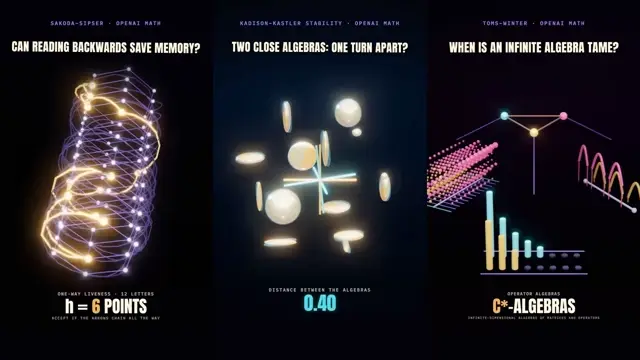
Sakoda–Sipser Problem: Can a machine that reads its input back and forth, with no guessing, be as small as one that guesses? Sakoda and Sipser asked this in 1978.
Explained: gradientdamage.com/p/129
Paper: github.com/openai/math/blob/main/preprints/An-exponential-two…
Weisfeiler–Leman Refinement: Weisfeiler–Leman refinement tells graphs apart by recolouring dots, pairs or k-tuples by what surrounds them; a higher dimension k sees more but costs more.
Explained: gradientdamage.com/p/133
Paper: github.com/openai/math/blob/main/preprints/Unconditional-time…
Depth-Five Lower Bounds: Multiply n matrices whose entries are all variables and take the top-left entry of the product: every term is a path through the matrices.
Explained: gradientdamage.com/p/135
Paper: github.com/openai/math/blob/main/preprints/Homogeneous-depth-…
PCP for PPAD: PPAD is the complexity class of End-of-the-Line problems: follow a path of arrows from a known start until it ends.
Explained: gradientdamage.com/p/136
Paper: github.com/openai/math/blob/main/preprints/The-PCP-for-PPAD-c…
The animations illustrate the results; they are not proofs.
Gradient Damage: mathematics you can see, equations you can hear.
youtube.com/@gradientdamage
Chapters
One problem per chapter. Each name links to the result's own page, each time to that moment on YouTube.
- Depth-3 Circuit Lower Bounds Theoretical computer science
- Courtade–Kumar Conjecture Theoretical computer science
- Trace Reconstruction Theoretical computer science
- Three-Machine Scheduling Theoretical computer science
- Metric k-Median Theoretical computer science
- Shortest Common Superstring Theoretical computer science
- Sakoda–Sipser Problem Theoretical computer science
- Weisfeiler–Leman Refinement Theoretical computer science
- Depth-Five Lower Bounds Theoretical computer science
- PCP for PPAD Theoretical computer science
Chapter 1: about the problem
Theoretical computer science·OpenAI Math·Result 112
Beyond the square-root exponent for depth-three circuits
Constructs a single language in deterministic polynomial time whose n-bit membership function requires 2ω(√n) total gates in unbounded-fan-in OR–AND–OR circuits, at every sufficiently large input length. This crosses the square-root-exponent threshold for explicit depth-three Boolean circuit lower bounds. (Lean)
Chapter 2: about the problem
Theoretical computer science·OpenAI Math·Result 119·from 0:21
The Courtade–Kumar and Hellinger conjectures
Proves the Courtade–Kumar conjecture: among Boolean functions of independent uniform bits, a single coordinate retains the most mutual information after independent bit-flip noise. A stronger theorem treats randomized binary summaries at fixed initial information. The Hellinger conjecture is also proved for every Boolean output bias and noise correlation. (Lean)
Chapter 3: about the problem
Theoretical computer science·OpenAI Math·Result 122·from 0:41
Quantitative trace-reconstruction bounds with a uniform decoder
At every fixed deletion probability in (0,1), reconstructing an arbitrary length-n binary string requires nΩ(log log n) independent traces, ruling out polynomial-sample reconstruction. A uniform decoder achieves quasipolynomial sample and running-time bounds for known fixed rational retention probabilities. When the deletion probability is at most n-ε for fixed ε > 0, both bounds become polynomial in the input and parameter encoding. (Lean)
Chapter 4: about the problem
Theoretical computer science·OpenAI Math·Result 124·from 1:02
Polynomial-time scheduling on three identical machines
Resolves the three-processor unit-job scheduling problem of Garey and Johnson: a deterministic polynomial-time algorithm minimizes makespan for nonpreemptive unit-length jobs with arbitrary precedence constraints on three identical parallel machines. For an explicitly given precedence graph, it decides deadline feasibility exactly and constructs a feasible schedule. (Lean)
Chapter 5: about the problem
Theoretical computer science·OpenAI Math·Result 125·from 1:23
The metric k-median approximation threshold and recovery
Gives a deterministic polynomial-time (1+2/e+ε)-approximation for finite rational metric k-median with specified candidate facilities, for every fixed ε > 0. Assuming P ≠ NP, the optimal infimum approximation factor is 1+2/e. (Lean)
Chapter 6: about the problem
Theoretical computer science·OpenAI Math·Result 128·from 1:43
A factor-two approximation for shortest common superstring
Gives a deterministic polynomial-time algorithm constructing a common superstring of length at most twice the optimum for every finite family of explicitly represented strings. The running time is polynomial in the full encoded input length, including symbol labels. (Lean)
Chapter 7: about the problem
Theoretical computer science·OpenAI Math·Result 129·from 2:03
Exponential state costs for two-way automata
Proves exponential lower bounds both for complementing two-way nondeterministic finite automata and for simulating one-way nondeterministic automata by two-way deterministic ones. The latter resolves the Sakoda–Sipser state-succinctness conjecture over growing finite alphabets; both results rule out polynomial state bounds independent of alphabet size. (Lean)
Chapter 8: about the problem
Theoretical computer science·OpenAI Math·Result 133·from 2:25
The computational complexity of Weisfeiler–Leman refinement
Proves unconditional nΩ(k) deterministic time lower bounds for joint and separate k-dimensional Weisfeiler–Leman equivalence, for sufficiently large fixed k in the specified sequential adjacency-matrix models. With dimension as input, joint equivalence is EXPTIME-complete even on subcubic graphs; deciding whether refinement identifies a graph is also EXPTIME-complete. (Lean)
Chapter 9: about the problem
Theoretical computer science·OpenAI Math·Result 135·from 2:46
Homogeneous depth-five lower bounds for iterated matrix multiplication
Over every characteristic-zero field, the (1,1) entry of a product of n independent n× n variable matrices requires nΘ(√n) gates in homogeneous depth-five sum–product circuits. This sharp bound allows shared gates and bottom linear forms involving all variables. (Lean)
Chapter 10: about the problem
Theoretical computer science·OpenAI Math·Result 136·from 3:06
A quasilinear PCP theorem for PPAD
Resolves the quasilinear PCP-for-PPAD conjecture. An End-of-Line instance of length N reduces to numerical circuit constraints of total length N(log N)O(1) such that any polynomially encoded rational assignment satisfying all but a fixed fraction to fixed accuracy yields an endpoint solution. Such assignments always exist, giving robust local verification with only quasilinear size overhead.
Topics
circuit lower boundsCourtade-Kumar conjecturetrace reconstructionthree machine schedulingk-medianshortest common superstringSakoda-Sipser conjectureWeisfeiler-Lemaniterated matrix multiplicationPCP for PPADTheoretical computer scienceOpenAI mathAI proofAI mathematicsmathsGradient Damage