Compilation··3:30·Convex and metric geometry
Petty's Projection Conjecture, Log Brunn–Minkowski Conjecture and 8 More
Watch on YouTubeAbout the problem →
About this video
10 results from OpenAI's public mathematics catalogue, one per chapter. Each chapter names the problem, shows the real objects, and states what OpenAI claims; none of it is peer reviewed yet.
Chapters:
0:00 Petty's Projection Conjecture
0:22 GNRS Conjecture for Planar Graphs
0:42 Triangular Lattice Universal Optimality
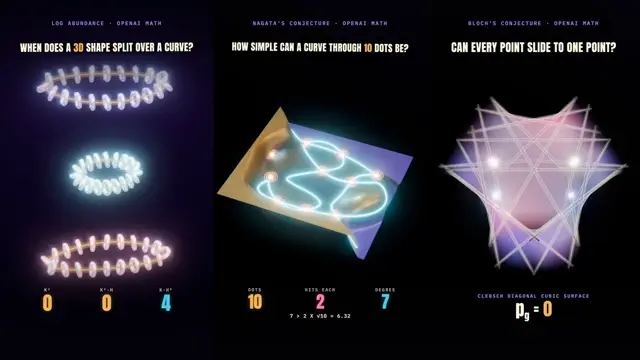
1:03 Log Brunn–Minkowski Conjecture
1:24 Covering Density of Convex Bodies
1:45 Dimension-Free Log-Sobolev Inequality
2:05 Gaussian Propeller Conjecture
2:26 Euclidean Steinitz–Bergström Bound
2:47 Lang–Plaut Problem
3:09 Edit Distance in ℓ1
Petty's Projection Conjecture: The projection body of a convex shape records the area of its shadow in every direction.
Explained: gradientdamage.com/p/088
Paper: github.com/openai/math/blob/main/preprints/Pettys-projection-…
GNRS Conjecture for Planar Graphs: The Gupta–Newman–Rabinovich–Sinclair (GNRS) conjecture asks whether the distances in planar graphs, and in any family closed under minors, can be drawn in L1 with only bounded stretch; an L1 map is exactly a weighted…
Explained: gradientdamage.com/p/089
Paper: github.com/openai/math/blob/main/preprints/Planar-Graph-Metri…
Triangular Lattice Universal Optimality: Scatter dots that repel each other and let them settle: they try to form the hexagonal, triangular lattice, but flaws get stuck.
Explained: gradientdamage.com/p/090
Paper: github.com/openai/math/blob/main/preprints/Universal-optimali…
Log Brunn–Minkowski Conjecture: The logarithmic Brunn–Minkowski conjecture (Böröczky, Lutwak, Yang and Zhang, 2012) says that for convex bodies K and L symmetric about the origin, the log mix (the body whose support function is h_K^(1−t) h_L^t) has…
Explained: gradientdamage.com/p/091
Paper: github.com/openai/math/blob/main/preprints/The-logarithmic-Br…
Covering Density of Convex Bodies: To cover all of space with translated copies of one convex shape, the copies must overlap; the covering density says how many times, on average, each point is covered.
Explained: gradientdamage.com/p/092
Paper: github.com/openai/math/blob/main/preprints/A-single-lattice-c…
Dimension-Free Log-Sobolev Inequality: A log-Sobolev inequality says the entropy of f² is at most a constant times the energy of f.
Explained: gradientdamage.com/p/093
Paper: github.com/openai/math/blob/main/preprints/A-dimension-free-l…
Gaussian Propeller Conjecture: Cut space into pieces and give each piece the pull of a bell-curve (Gaussian) cloud: its Gaussian first moment.
Explained: gradientdamage.com/p/096
Paper: github.com/openai/math/blob/main/preprints/The-Gaussian-Prope…
Euclidean Steinitz–Bergström Bound: Take any list of vectors of length at most 1 in d dimensions.
Explained: gradientdamage.com/p/097
Paper: github.com/openai/math/blob/main/preprints/The-Euclidean-Stei…
Lang–Plaut Problem: Can every doubling metric space be fitted into some finite-dimensional space without distorting distances by more than a constant factor? Lang and Plaut asked this for doubling subsets of Hilbert space.
Explained: gradientdamage.com/p/098
Paper: github.com/openai/math/blob/main/preprints/A-doubling-Hilbert…
Edit Distance in ℓ1: Edit distance counts the fewest single-letter insertions, deletions and substitutions turning one word into another; it is hard to compute with, so one asks how faithfully it can be mapped into the flat ℓ1 (taxicab)…
Explained: gradientdamage.com/p/099
Paper: github.com/openai/math/blob/main/preprints/Edit-Distance-in-l…
The animations illustrate the results; they are not proofs.
Gradient Damage: mathematics you can see, equations you can hear.
youtube.com/@gradientdamage
Chapters
One problem per chapter. Each name links to the result's own page, each time to that moment on YouTube.
- Petty's Projection Conjecture Convex and metric geometry
- GNRS Conjecture for Planar Graphs Convex and metric geometry
- Triangular Lattice Universal Optimality Convex and metric geometry
- Log Brunn–Minkowski Conjecture Convex and metric geometry
- Covering Density of Convex Bodies Convex and metric geometry
- Dimension-Free Log-Sobolev Inequality Convex and metric geometry
- Gaussian Propeller Conjecture Convex and metric geometry
- Euclidean Steinitz–Bergström Bound Convex and metric geometry
- Lang–Plaut Problem Convex and metric geometry
- Edit Distance in ℓ1 Convex and metric geometry
Chapter 1: about the problem
Convex and metric geometry·OpenAI Math·Result 088
Sharp projection-body inequalities and a counterexample to simplex maximization
Proves Petty's projection-volume conjecture in the remaining dimensions n ≥ 4: ellipsoids uniquely minimize projection-body volume at fixed body volume. Also establishes the full Lutwak–Petty projection inequalities. In contrast, products of simplices exceed Brannen's proposed simplex maximum for normalized projection-body volume by an exponential factor in every sufficiently large dimension. (Lean)
Chapter 2: about the problem
Convex and metric geometry·OpenAI Math·Result 089·from 0:22
Bounded-distortion L1 embeddings of planar and bounded-treewidth graphs
Resolves the planar and bounded-treewidth cases of the Gupta–Newman–Rabinovich–Sinclair conjecture. Shortest-path metrics of finite connected graphs with arbitrary positive edge lengths embed into real L1 with universal distortion for planar graphs, and distortion depending only on treewidth for bounded-treewidth graphs. The corresponding multicommodity flow–cut gaps are uniformly bounded. (Lean)
Chapter 3: about the problem
Convex and metric geometry·OpenAI Math·Result 090·from 0:42
Triangular-lattice optimality, long-range Riesz and Coulomb energies, and spherical logarithmic energy
Proves that the triangular lattice minimizes the lower limit of energy per particle for every nonnegative completely monotone potential of squared distance among locally finite planar configurations of centered-disk density one. It also minimizes unit-background renormalized Riesz energies for 0 < s < 2 and Coulomb energy, resolving Sandier–Serfaty and the two-dimensional Brauchart–Hardin–Saff conjecture on the linear term of optimal spherical logarithmic energy. (Lean)
Chapter 4: about the problem
Convex and metric geometry·OpenAI Math·Result 091·from 1:03
Logarithmic and Lp Brunn–Minkowski inequalities and the B-conjecture
Proves the logarithmic Brunn–Minkowski inequality for origin-symmetric convex bodies in every dimension, and the scalar-dilation B-conjecture for all even log-concave Radon measures. For Lebesgue volume it also proves the additive Lp Brunn–Minkowski inequality for full-dimensional origin-symmetric convex bodies throughout 0 < p < 1. (Lean)
Chapter 5: about the problem
Convex and metric geometry·OpenAI Math·Result 092·from 1:24
The optimal order of convex-body covering density
Determines the optimal worst-case covering density as Θ(n log n), for both lattice and unrestricted translative coverings. Every convex body in ℝn, n ≥ 2, admits a lattice covering of density at most Cn log n; centrally symmetric examples in every sufficiently large dimension require at least cn log n even without the lattice restriction, for absolute c,C > 0. (Lean)
Chapter 6: about the problem
Convex and metric geometry·OpenAI Math·Result 093·from 1:45
Dimension-free logarithmic Sobolev inequality for subgaussian log-concave measures
Proves a dimension-free logarithmic Sobolev inequality for centered log-concave densities with uniformly subgaussian linear marginals, with constant bounded by a universal multiple of the squared linear subgaussian parameter.
Chapter 7: about the problem
Convex and metric geometry·OpenAI Math·Result 096·from 2:05
The Gaussian propeller conjecture in every dimension
Proves that the sum of squared Gaussian first moments of any finite measurable partition is at most 9/(8π). In dimension at least two, three planar sectors of angle 2π/3, extended orthogonally, attain the bound. Combined with the separate Unique Games theorem, this proves NP-hardness of improving the loss factor (8π/9)(1-1/k) for identity-target kernel clustering with fixed k ≥ 3 on rational centered positive semidefinite inputs. (Lean)
Chapter 8: about the problem
Convex and metric geometry·OpenAI Math·Result 097·from 2:26
The Euclidean Steinitz–Bergström bound
Proves that any finite sequence in the Euclidean unit ball of ℝd admits signs keeping every partial sum within C√d, independently of length. Consequently every zero-sum family can be reordered with the same bound on unsigned partial sums. A matching lower bound gives the optimal order S2(d)=Θ(√d). (Lean)
Chapter 9: about the problem
Convex and metric geometry·OpenAI Math·Result 098·from 2:47
Compact counterexamples to bi-Lipschitz dimension reduction
Every infinite-dimensional real Banach space contains a compact doubling set that admits no bi-Lipschitz embedding into any finite-dimensional normed space. The doubling constant is universal. This answers the Lang–Plaut problem negatively, even for compact subsets of Hilbert space. (Lean)
Chapter 10: about the problem
Convex and metric geometry·OpenAI Math·Result 099·from 3:09
The sharp exponential scale of edit-distance distortion
Determines the least distortion of embedding edit distance on words of length at most d into real ℓ1: it is exp(Θ(√(log d log log d))). Insertions, deletions and substitutions have unit cost. The constants are uniform over all finite alphabets with at least two symbols, even when the alphabet grows with d; binary words already force the lower bound. (Lean)
Topics
Petty projection conjectureGNRS conjecturetriangular latticelog Brunn-Minkowski conjecturecovering densitylog-Sobolev inequalityGaussian propeller conjectureSteinitz lemmaLang-Plaut problemedit distanceConvex and metric geometryOpenAI mathAI proofAI mathematicsmathsGradient Damage