Compilation··3:28·Number theory
Zilber–Pink Conjecture, Duffin–Schaeffer Conjecture and 8 More in Number Theory
Watch on YouTubeAbout the problem →
About this video
10 results from OpenAI's public mathematics catalogue, one per chapter. Each chapter names the problem, shows the real objects, and states what OpenAI claims; none of it is peer reviewed yet.
Chapters:
0:00 Chowla Conjecture, Two-Point Case
0:21 Bogomolov–Pop Conjecture
0:42 Fontaine–Mazur Conjecture at the Prime 2
1:03 Duke's Theorem in Higher Degree
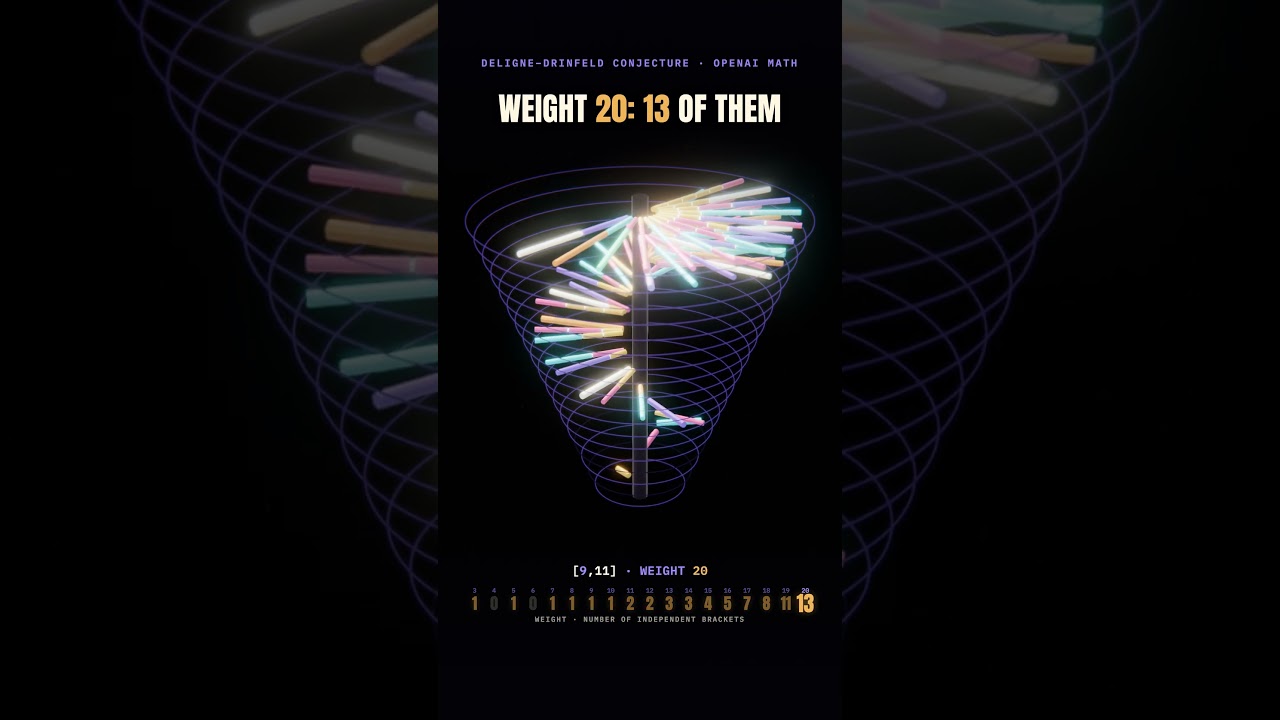
1:24 Zilber–Pink Conjecture
1:45 Margulis–Platonov Conjecture
2:07 Grothendieck's Section Conjecture
2:27 Squarefree Values of Quartics
2:48 Jacobsthal's Function
3:08 Duffin–Schaeffer Conjecture
Chowla Conjecture, Two-Point Case: Liouville's function gives each whole number +1 if it has an even number of prime factors and −1 if odd.
Explained: gradientdamage.com/p/007
Paper: github.com/openai/math/blob/main/preprints/Ordinary-two-point…
Bogomolov–Pop Conjecture: The Bogomolov–Pop conjecture asks whether a function field of dimension at least two over an algebraically closed field can be rebuilt from a tiny shadow of itself: its multiplicative structure modulo a prime ℓ (Milnor…
Explained: gradientdamage.com/p/009
Paper: github.com/openai/math/blob/main/preprints/Reconstruction-of-…
Fontaine–Mazur Conjecture at the Prime 2: Modularity says the point counts of a curve modulo every prime are secretly the coefficients of a modular form; for elliptic curves this was proved between 1995 and 2001.
Explained: gradientdamage.com/p/010
Paper: github.com/openai/math/blob/main/preprints/Unrestricted-pro-m…
Duke's Theorem in Higher Degree: Duke's theorem (1988) says the closed orbits coming from the ideal classes of a real quadratic field spread out evenly over the space of lattices as the discriminant grows, with no mass escaping into the cusp.
Explained: gradientdamage.com/p/015
Paper: github.com/openai/math/blob/main/preprints/Equidistribution-o…
Zilber–Pink Conjecture: The Zilber–Pink conjecture says "unlikely intersections" are rare: a subvariety of an abelian variety meets the special subvarieties more than dimension counting allows only finitely often.
Explained: gradientdamage.com/p/016
Paper: github.com/openai/math/blob/main/preprints/The-Abelian-Zilber…
Margulis–Platonov Conjecture: The Margulis–Platonov conjecture describes every normal subgroup of the rational points G(k) of an absolutely almost simple, simply connected algebraic group over a global field k: each noncentral one should come from…
Explained: gradientdamage.com/p/018
Paper: github.com/openai/math/blob/main/preprints/The-Margulis-Plato…
Grothendieck's Section Conjecture: Grothendieck's section conjecture (1983) predicts that the rational points of a curve of genus at least two are exactly the sections of its arithmetic étale fundamental group, up to conjugacy.
Explained: gradientdamage.com/p/019
Paper: github.com/openai/math/blob/main/preprints/Etale-covers-with-…
Squarefree Values of Quartics: A number is squarefree when no prime square divides it.
Explained: gradientdamage.com/p/020
Paper: github.com/openai/math/blob/main/preprints/Squarefree-values-…
Jacobsthal's Function: Pick k primes: how many consecutive whole numbers can all be divisible by at least one of them before a number slips through? Jacobsthal asked whether that longest run h(k) is always at most a constant times k², and the…
Explained: gradientdamage.com/p/021
Paper: github.com/openai/math/blob/main/preprints/A-quadratic-bound-…
Duffin–Schaeffer Conjecture: Pick a number x and a shift γ, and ask how often qx lands within ψ(q) of γ modulo 1 as q = 1, 2, 3, … grows.
Explained: gradientdamage.com/p/022
Paper: github.com/openai/math/blob/main/preprints/The-weak-inhomogen…
The animations illustrate the results; they are not proofs.
Gradient Damage: mathematics you can see, equations you can hear.
youtube.com/@gradientdamage
Chapters
One problem per chapter. Each name links to the result's own page, each time to that moment on YouTube.
- Chowla Conjecture, Two-Point Case Number theory
- Bogomolov–Pop Conjecture Number theory
- Fontaine–Mazur Conjecture at the Prime 2 Number theory
- Duke's Theorem in Higher Degree Number theory
- Zilber–Pink Conjecture Number theory
- Margulis–Platonov Conjecture Number theory
- Grothendieck's Section Conjecture Number theory
- Squarefree Values of Quartics Number theory
- Jacobsthal's Function Number theory
- Duffin–Schaeffer Conjecture Number theory
Chapter 1: about the problem
Number theory·OpenAI Math·Result 007
Ordinary two-point correlations and the corrected Elliott conjecture
Proves the ordinary two-point Chowla conjecture, with a bound O(X/(log X)c) for Liouville correlation sums along fixed nonproportional affine forms, where c > 0 is absolute. More generally, proves the binary corrected Elliott conjecture for complex multiplicative functions bounded by one when one factor is uniformly nonpretentious against each fixed Dirichlet character times nit for |t| ≤ X. (Lean)
Chapter 2: about the problem
Number theory·OpenAI Math·Result 009·from 0:21
Function-field reconstruction from Milnor K-theory and Galois data
Reconstructs function fields of transcendence degree at least two over algebraically closed constants from KM1/ℓ, KM2/ℓ, and their product. These data recover the perfect closure and constants when ℓ differs from the characteristic, and the original field and its named base in equal characteristic. Also proves Bogomolov–Pop reconstruction from abelian-by-central pro-ℓ Galois data away from the characteristic. (Lean)
Chapter 3: about the problem
Number theory·OpenAI Math·Result 010·from 0:42
Unrestricted pro-modularity at the prime two
Every continuous odd absolutely irreducible two-dimensional 2-adic representation of Gℚ unramified outside finitely many primes occurs in a completed Hecke algebra at some odd tame level. Also proves classical modularity up to Tate twist for irreducible odd representations with these finiteness conditions that are de Rham at 2 with distinct Hodge–Tate weights, resolving the dyadic Fontaine–Mazur case without residual restrictions.
Chapter 4: about the problem
Number theory·OpenAI Math·Result 015·from 1:03
Torus-packet equidistribution in prime, quartic, and sextic degrees
Proves Haar equidistribution without escape of mass for complete volume-weighted torus packets from totally real fields: arbitrary lattices and prescribed local types in fixed prime degree at least five, arbitrary-order Picard packets in primitive quartic fields, and maximal-order ideal-class packets in primitive sextic fields. Here primitive means having no proper intermediate field; the relevant order or field discriminant tends to infinity. (Lean)
Chapter 5: about the problem
Number theory·OpenAI Math·Result 016·from 1:24
Zilber–Pink in abelian varieties and the Siegel threefold
Proves the abelian Zilber–Pink conjecture over ℚ̅: every irreducible subvariety has finitely many maximal atypical subvarieties relative to its smallest containing torsion coset. It also proves the full curve case in the Siegel threefold 𝒜2 for Hodge-generic curves defined over ℚ̅, without boundary or reduction assumptions.
Chapter 6: about the problem
Number theory·OpenAI Math·Result 018·from 1:45
The Margulis–Platonov conjecture over global fields
Proves the Margulis–Platonov conjecture over every global field, including function fields of characteristic two. For an absolutely almost simple simply connected algebraic group G over k, every noncentral abstract normal subgroup of G(k) is the inverse image of an open normal subgroup in the finite product of its anisotropic nonarchimedean local groups.
Chapter 7: about the problem
Number theory·OpenAI Math·Result 019·from 2:07
The local p-adic section conjecture and global consequences
Proves that rational points on every smooth proper geometrically connected curve of genus at least two over a finite extension of ℚp correspond bijectively to conjugacy classes of sections of its full arithmetic étale fundamental group. It also proves Grothendieck's section conjecture over ℚ for the modular curves X0(N) and X1(N) of genus at least two.
Chapter 8: about the problem
Number theory·OpenAI Math·Result 020·from 2:27
Squarefree quartics and power-free polynomial values
Proves the squarefree-values conjecture for irreducible integer quartics with no fixed prime-square divisor: squarefree values on positive integers have the predicted positive Euler-product density. More generally, establishes the (d-2)-power-free density for irreducible integer polynomials of degrees four through eight under the necessary local condition; together with Browning's higher-degree theorem, this covers every d ≥ 4. (Lean)
Chapter 9: about the problem
Number theory·OpenAI Math·Result 021·from 2:48
A quadratic bound for Jacobsthal’s function
Answers Jacobsthal's quadratic-bound question: every interval of Ck2 consecutive integers contains an integer coprime to any prescribed positive integer with at most k distinct prime divisors, for an absolute constant C. The bound is uniform over prime sets and interval positions and removes the classical logarithmic loss. (Lean)
Chapter 10: about the problem
Number theory·OpenAI Math·Result 022·from 3:08
The weak inhomogeneous Duffin–Schaeffer conjecture
Proves that for every real shift γ and finite-valued ψ:ℕ → [0,∞), divergence of ∑qϕ(q)ψ(q)/q implies ‖qx-γ‖ < ψ(q) for infinitely many q, for almost every x. Here ϕ is Euler's totient and the norm is distance to the nearest integer. Numerators are unrestricted; no monotonicity or Diophantine condition on γ is needed.
Topics
Chowla conjectureBogomolov–Pop conjectureFontaine-Mazur conjecturetorus packetsZilber-Pink conjectureMargulis-Platonov conjecturesection conjecturesquarefree values of polynomialsJacobsthal functionDuffin-Schaeffer conjectureNumber theoryOpenAI mathAI proofAI mathematicsmathsGradient Damage