Short··0:21·Number theory
Duffin–Schaeffer Conjecture: OpenAI Claims the Inhomogeneous Case
Watch on YouTubeAbout the problem →
About this video
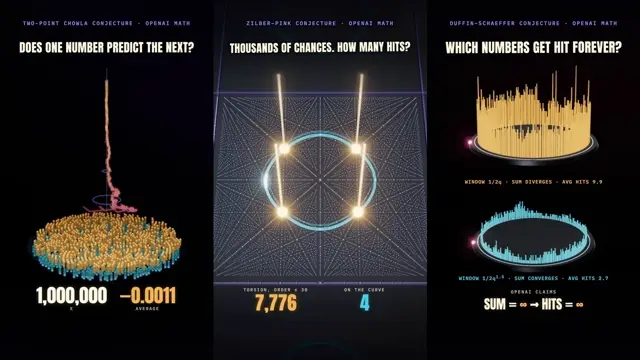
Pick a number x and a shift γ, and ask how often qx lands within ψ(q) of γ modulo 1 as q = 1, 2, 3, … grows. The weak inhomogeneous Duffin–Schaeffer conjecture says that if the sum of φ(q)ψ(q)/q diverges (φ is Euler's totient), then almost every x is hit infinitely often, for any shift γ and any numerators. OpenAI claims a proof with no monotonicity condition on ψ and no Diophantine condition on γ; this is OpenAI's preprint, not yet peer reviewed. The two crowns are real counts for 360 points up to q = 10,000: gold uses a divergent ψ, cyan a convergent one.
Paper (OpenAI, catalogue result 022):
- The Weak Inhomogeneous Duffin–Schaeffer Conjecture: github.com/openai/math/blob/main/preprints/The-weak-inhomogen…
The animation illustrates the result; it is not a proof.
Gradient Damage: mathematics you can see, equations you can hear.
youtube.com/@gradientdamage
Every result explained: gradientdamage.com/p/022
About the problem
Number theory·OpenAI Math·Result 022
The weak inhomogeneous Duffin–Schaeffer conjecture
Proves that for every real shift γ and finite-valued ψ:ℕ → [0,∞), divergence of ∑qϕ(q)ψ(q)/q implies ‖qx-γ‖ < ψ(q) for infinitely many q, for almost every x. Here ϕ is Euler's totient and the norm is distance to the nearest integer. Numerators are unrestricted; no monotonicity or Diophantine condition on γ is needed.
Topics
Duffin-Schaeffer conjectureinhomogeneous Duffin-Schaeffer conjectureweak inhomogeneous Duffin-SchaefferDiophantine approximationmetric number theoryKhintchine theoreminhomogeneous Diophantine approximationEuler totientalmost every real numberKoukoulopoulos Maynardnumber theoryOpenAIOpenAI mathAI mathematicsAI proofmathsmathematicsmath shorts3D animation