Explainer·OpenAI Math
OpenAI's Navier–Stokes proof: what it claims, and what it does not
On 8 September 2026 OpenAI said an internal model had proved that the three-dimensional Navier–Stokes equations can blow up in finite time when a smooth force is applied. That is a real statement about a Millennium Prize problem, and a narrower one than "OpenAI solved Navier–Stokes".
01The problem, in one paragraph
The Navier–Stokes equations describe how a viscous fluid moves. The Clay Mathematics Institute's Millennium Prize formulation, written by Charles Fefferman, offers four ways to settle the three-dimensional case: prove that smooth solutions always exist on all of space (A) or on the periodic torus (B), or show that they can break down, on space (C) or on the torus (D). In C and D the breakdown may be produced with the help of a smooth external force; in A and B there is no force. Settling any one of the four counts for the prize under Clay's rules, which also govern how credit is assigned.
02What OpenAI claims
OpenAI's repository NavierStokesAndEuler states the result as two theorems, one for each setting, holding for every positive viscosity:
- Whole space ℝ³. There exist smooth initial data and smooth forcing for which no global smooth solution with uniformly bounded kinetic energy exists.
- Periodic torus ℝ³/ℤ³. There exist smooth periodic initial data and forcing for which no global smooth solution exists.
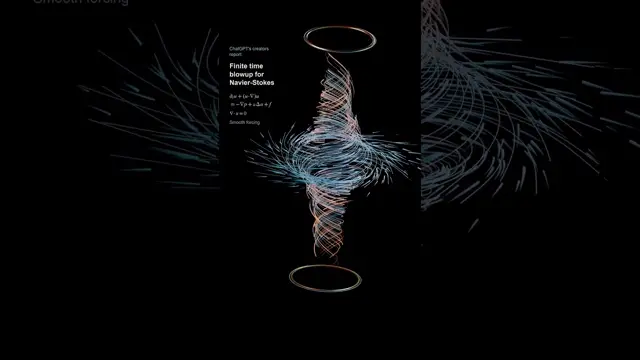
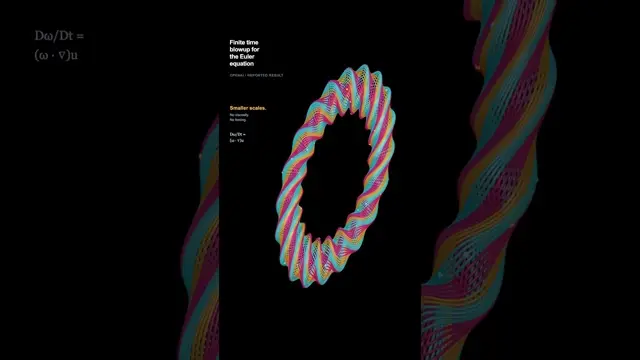
In the channel's film the construction is described as a flow that starts from rest, keeps bounded energy, and develops unbounded velocity in finite time. OpenAI attributes the work to an internal research model and coordinated agents, not to the public ChatGPT product, and says the proof runs to about a hundred pages. A companion paper reports finite-time blowup for the unforced incompressible Euler equations (no viscosity) from smooth, compactly supported initial data: the velocity's C¹ norm becomes unbounded and the time integral of the vorticity's L∞ norm diverges. Both results come with Lean 4 formalisations and instructions for independent checking.
03What it does not claim
The result does not touch alternatives A and B. Whether the unforced Navier–Stokes equations can blow up, or always stay smooth, is as open as it was. The forced route was opened by Diego Córdoba and Luis Martínez-Zoroa, who constructed blowup with rough forcing; OpenAI's result, and independently the 8 September results of Tristan Buckmaster and Levent Alpöge for the porous media, Boussinesq and Euler equations, push that programme to smooth forcing. Both sides credit Córdoba and Martínez-Zoroa for the idea.
04Status
- The paper is a preprint. The Lean formalisation covers the stated theorems; it has not been through journal peer review.
- The Clay Mathematics Institute noted the announcement on 11 September and said its evaluation would be deliberately unhurried, under the Millennium Prize rules.
- The result is not part of the OpenAI Math catalogue of 372 families; it lives in its own repository. A different forced Navier–Stokes result, on universal computation in viscous flows, is in the catalogue as result 376.
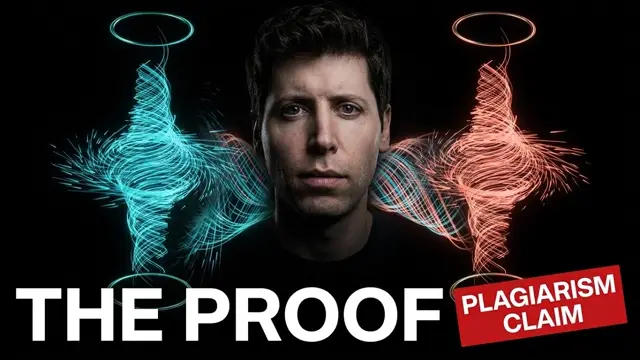
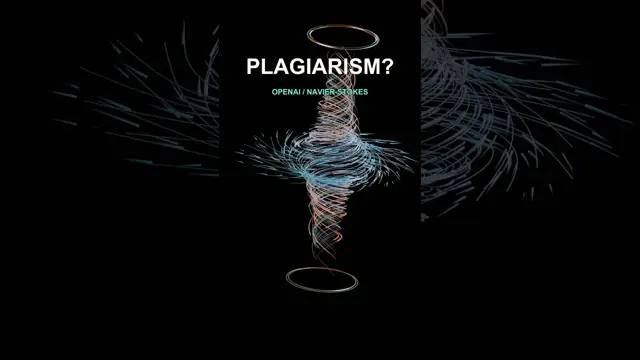
- The announcement is also the subject of an authorship dispute between OpenAI researchers and Tristan Buckmaster. That is about credit and conduct, not about whether the proof is right; it is set out on the page OpenAI math plagiarism: what is alleged, by whom, and what OpenAI says.
05The channel's videos
The Short above illustrates the vortex mechanism of the forced construction with an original incompressible schematic field; it is an illustrative loop, not a numerical solution of the paper's construction and not a verification. A second Short illustrates the Euler result, and the 9-minute film covers the dispute.
06Sources
- OpenAI, NavierStokesAndEuler: statements of the results, Lean 4 formalisations, checking instructionsGitHub
- OpenAI, Finite time blowup for Navier–StokesPreprint · PDF
- OpenAI, Finite time blowup for the Euler equationPreprint · PDF
- OpenAI, On the Navier-Stokes Millennium Prize Problem8 September 2026, updated 10 September
- Charles Fefferman, Existence and smoothness of the Navier–Stokes equationClay Mathematics Institute · the official problem statement, alternatives A to D · PDF
- Clay Mathematics Institute, Navier–Stokes announcement11 September 2026
- Tristan Buckmaster, statement8 September 2026 · PDF