Explainer·OpenAI Math
OpenAI math plagiarism: what is alleged, by whom, and what OpenAI says
"OpenAI math plagiarism" covers three separate disputes from August and September 2026, with different people, different results and different claims. None has been settled by any institution. This page says what each one alleges, what OpenAI has said, and what is not in dispute.
01The short version
In August 2026 mathematicians told Scientific American that two of OpenAI's announced results reused ideas from recent papers without citing them. In September, after OpenAI announced a finite-time blowup result for the forced Navier–Stokes equations, the NYU mathematician Tristan Buckmaster published a four-page account of calls with OpenAI researchers in which, he says, he was offered authorship arrangements that would have removed his collaborator, who works at Anthropic, from the paper. OpenAI's leadership called the plagiarism allegation unfounded. On 11 September more than two dozen Fields Medallists signed a declaration warning of "severe attribution and plagiarism questions" in AI-produced mathematics, without naming OpenAI.
These are claims about credit and conduct. None of them says the mathematics is wrong. Whether the proofs hold is a separate question, and for every result on this site the answer so far is the same: preprint, not peer reviewed.
021. Navier–Stokes: the authorship dispute
What OpenAI announced
On 8 September 2026 OpenAI said an internal model had produced a proof of finite-time blowup for the three-dimensional incompressible Navier–Stokes equations with smooth forcing: a flow that starts from rest, keeps bounded energy, and develops unbounded velocity in finite time. In the Clay Mathematics Institute's formulation of the Millennium problem these are alternatives C and D. The announcement does not claim the unforced case, which is what most people mean by "the Navier–Stokes problem". OpenAI attributes the work to an internal research model and coordinated agents, not to the public ChatGPT product. What exactly is claimed, and what is not, is set out on OpenAI's Navier–Stokes proof: what it claims, and what it does not. The result is published separately from the OpenAI Math catalogue, in the repository NavierStokesAndEuler, with a Lean formalisation and instructions for independent checking.
What Buckmaster says happened
Tristan Buckmaster (NYU) and Levent Alpöge (who works at Anthropic) had spent about a year, as a personal collaboration using several LLMs, pushing a programme of Diego Córdoba and Luis Martínez-Zoroa from rough to smooth forcing. On 8 September they posted forced-blowup results for the incompressible porous media, Boussinesq and 3D Euler equations, with Lean verification. The same day Buckmaster published a statement describing what preceded it:
- On 3 September, with a rumour circulating that "Anthropic" had solved a major open problem, he wrote to a mathematician at OpenAI to explain that the work was personal and would be posted shortly.
- On 6 September, in two calls that Sébastien Bubeck joined, he was told an internal OpenAI model had proved forced blowup for Navier–Stokes, on the same smooth-forcing route he and Alpöge had quietly chosen. He says he was first told the model had simply been given the problem statement, and that it emerged during the call that a team had worked on it, starting from easier problems, with a great deal of compute, and that the first prompt had been sent "in the past few days".
- He says two arrangements were proposed: post Euler first and let OpenAI post Navier–Stokes the next day, or write up the Navier–Stokes result himself with Alpöge removed as an author. He declined both. He reports being asked, when he said he would go public, "Why would you ruin your career?"
- He asked whether the model had been trained on, or had access to, the Codex sessions into which the two had put their drafts; he says he was told the model did not look up user data, and that the training question went unanswered.
He is explicit about the limits of his claim: "I am not accusing anyone of anything." He has not seen OpenAI's proof and does not know whether their data was used.
What OpenAI and its researchers say
Sam Altman called the plagiarism allegations unfounded. OpenAI says its investigation ruled out any influence from Buckmaster's recent prompts on the result. Bubeck posted a response on 8 September giving his account of the calls; he apologised for the remark about Buckmaster's career and says he withdrew it during the conversation. OpenAI's own page on the result was updated on 10 September. The private calls remain disputed: the two accounts differ on what was offered and why, and nothing public resolves them.
What is not disputed
- The smooth-forcing route is due to Córdoba and Martínez-Zoroa, and both sides credit it.
- OpenAI's result is the forced case (alternatives C and D), not the unforced Millennium problem.
- The Clay Mathematics Institute said on 11 September that its evaluation would be "deliberately unhurried". No prize has been awarded.
032. Sphere packing and sofic groups: the attribution claims
On 6 August 2026 Scientific American reported that two of OpenAI's most prominent results used ideas from the recent literature without citing them.
- Sphere packing. Stephen Miller (Yeshiva University) said the proof relies on an argument from a 2016 paper of his with a collaborator, presented as the paper's own, and described the pattern as systematic and as research misconduct.
- Sofic groups. Francesco Fournier-Facio (Cambridge) and Andreas Thom (TU Dresden) said the key step combines a 2016 paper by Gábor Kun with Kun and Thom's 2019 paper, which made the result less novel than it first appeared.
OpenAI's response, through a spokesperson: "We take responsibility for the correctness of these results", with "small updates" to the papers to follow in line with academic practice. OpenAI also revised its press release, which had said the problems had seen no progress for at least a decade. The catalogue's own README now says that some outputs build on earlier results and that corrections are recorded as new versions.
043. The Fields Medallists' declaration
On 11 September 2026 a declaration titled A Severe Misalignment of AI in Mathematics was published with the signatures of more than two dozen Fields Medallists, among them Terence Tao, Peter Scholze, Maryna Viazovska and Martin Hairer. It does not name OpenAI or any result. It argues that treating open problems as benchmarks conflicts with the aims of the mathematical community, that rushed announcements leave no time for proper write-ups or for citing prior work, and that this raises "severe attribution and plagiarism questions". The same week, TechCrunch reported that OpenAI withdrew its sponsorship of a mathematics event at Caltech after criticism from researchers there.
05What this means for the 372 results
The Navier–Stokes result is not one of the 372 results in the OpenAI Math catalogue; a different forced Navier–Stokes result, on universal computation in fluid flows, is (result 376). The attribution disputes concern specific papers, and the declaration concerns the practice. For the catalogue as a whole the position is unchanged: every result is a preprint attributed to an unreleased internal OpenAI model, OpenAI's own README puts about 42% of the top-line results as formalised in Lean, none has been peer reviewed, and OpenAI records corrections and withdrawals as new versions. This site reports the claims; it does not certify them, and it takes no side in the disputes.
06The channel's coverage
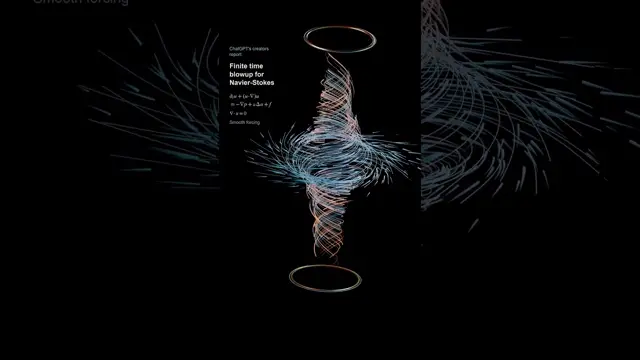
The 9-minute film above follows the Navier–Stokes dispute through the public accounts of Buckmaster, Bubeck and Altman and then separates the mathematics from the disputed private conversation. Two Shorts summarise it, and two earlier Shorts illustrate the forced Navier–Stokes and Euler results themselves. The animations illustrate the statements; they are not proofs.
07Sources
- Tristan Buckmaster, statement8 September 2026 · PDF
- OpenAI, On the Navier-Stokes Millennium Prize Problem8 September 2026, updated 10 September
- Sébastien Bubeck, response8 September 2026
- OpenAI, NavierStokesAndEuler: statements and verification instructionsGitHub
- Clay Mathematics Institute, Navier–Stokes announcement11 September 2026
- Charles Fefferman, the official problem statementClay Mathematics Institute · PDF
- Scientific American, OpenAI's latest math breakthroughs commit research misconduct, experts say6 August 2026
- A Severe Misalignment of AI in Mathematics11 September 2026
- TechCrunch, OpenAI's feud with mathematicians is only escalating11 September 2026
- OpenAI, the math results catalogueGitHub, September to October 2026