Short··0:12
Finite time blowup for the Euler equation
About this video
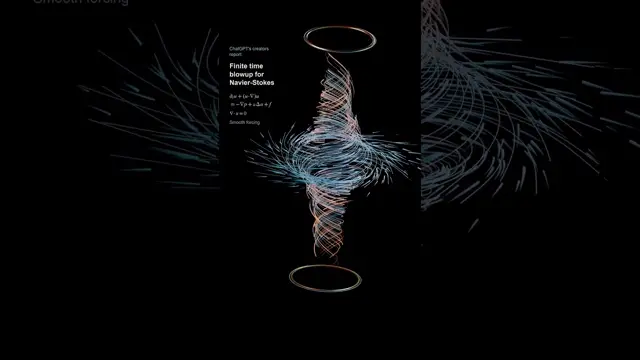
How can a smooth ideal fluid develop unbounded gradients? OpenAI's manuscript, Finite time blowup for the Euler equation, reports finite-time breakdown from smooth, compactly supported initial data for the unforced incompressible 3D Euler equation. This is the inviscid Euler result, separate from the forced Navier-Stokes manuscript.
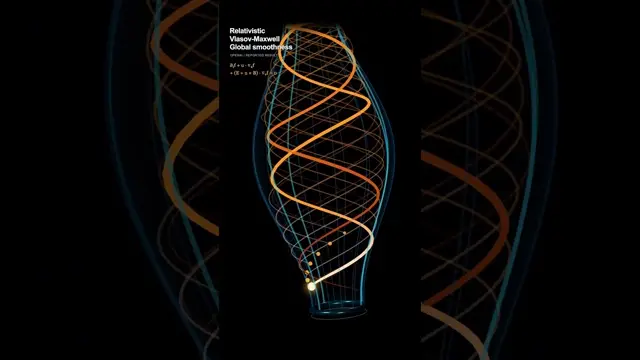
About the animation: A closed bundle of corrugated filament centerlines stretches and contracts under an affine map with determinant one. Tube thickness stays constant for legibility, so the rendered tubes themselves are not a volume measurement. It visualizes stretching and finer transverse scales. This is an illustrative loop, not the paper's constructed Euler solution or a numerical demonstration of singularity formation. The finite display returns to its starting state for the loop.
Paper: cdn.openai.com/pdf/315b36cd-ec98-4023-8342-93345194ece1/euler…
GitHub materials: github.com/openai/NavierStokesAndEuler
Repository: github.com/openai/NavierStokesAndEuler
Source-reported result. This visual explanation is not an independent proof audit or a verification of the formalization.
'Titan' by Scott Buckley - released under CC-BY 4.0. www.scottbuckley.com.au
scottbuckley.com.au/library/titan/
Licence: creativecommons.org/licenses/by/4.0/
Music edits: Excerpted, crossfaded to loop, volume adjusted.
Topics
Finite time blowup for the Euler equationEuler equationEuler blowupincompressible Eulerfluid dynamicsvorticityvortex stretchingpartial differential equationsmathematicsOpenAI math3D math animation