Compilation··3:07·Theoretical computer science
L = BPL, Matrix Multiplication Exponent, Integer Multiplication and 6 More
Watch on YouTubeAbout the problem →
About this video
9 results from OpenAI's public mathematics catalogue, one per chapter. Each chapter names the problem, shows the real objects, and states what OpenAI claims; none of it is peer reviewed yet.
Chapters:
0:00 One-Tape Turing Machines
0:21 Log-Concave Sampling
0:41 Memory-Sample Lower Bounds
1:02 Existential Theory of the Reals
1:23 L = BPL
1:43 Matrix Multiplication Exponent
2:04 Integer Multiplication
2:25 Counting Perfect Matchings
2:45 Counting Common Matroid Bases
One-Tape Turing Machines: How much memory do you need to replay T steps of a computation, if you can take as long as you like? For a Turing machine with one tape and one head, the classical answer was about the square root of T.
Explained: gradientdamage.com/p/137
Paper: github.com/openai/math/blob/main/preprints/Simulating-One-Tap…
Log-Concave Sampling: To draw random samples from a log-concave distribution exp(−V), an algorithm asks an oracle for the value and slope of V at chosen points.
Explained: gradientdamage.com/p/139
Paper: github.com/openai/math/blob/main/preprints/Subpolynomial-quer…
Memory-Sample Lower Bounds: A hidden direction in d dimensions, and every clue is one exact random measurement of it.
Explained: gradientdamage.com/p/140
Paper: github.com/openai/math/blob/main/preprints/Memory-and-precisi…
Existential Theory of the Reals: The existential theory of the reals asks whether a system of polynomial equations and inequalities with integer coefficients has a real solution.
Explained: gradientdamage.com/p/141
Paper: github.com/openai/math/blob/main/preprints/Existential-univer…
L = BPL: A machine with a tiny memory (logarithmic space) reads its input and flips coins.
Explained: gradientdamage.com/p/103
Paper: github.com/openai/math/blob/main/preprints/Exact-Derandomizat…
Matrix Multiplication Exponent: Multiplying two n by n matrices the school way takes n³ multiplications.
Explained: gradientdamage.com/p/107
Paper: github.com/openai/math/blob/main/preprints/Matrix-Multiplicat…
Integer Multiplication: How fast can a computer multiply two n-digit numbers? The schoolbook method costs about n² digit products.
Explained: gradientdamage.com/p/109
Paper: github.com/openai/math/blob/main/preprints/Integer-multiplica…
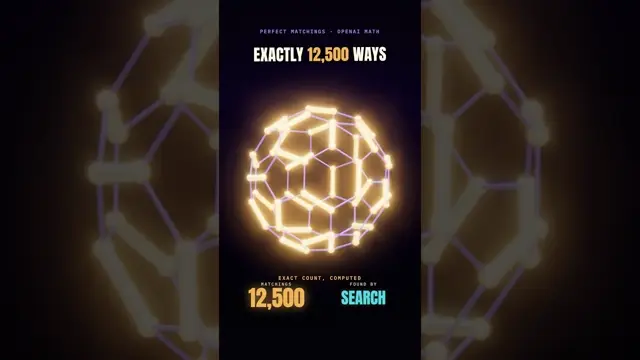
Counting Perfect Matchings: A perfect matching pairs every vertex of a graph with exactly one neighbour, like the double bonds of a molecule.
Explained: gradientdamage.com/p/113
Paper: github.com/openai/math/blob/main/preprints/A-Fully-Polynomial…
Counting Common Matroid Bases: A matroid is a rule for which sets of edges or elements count as independent.
Explained: gradientdamage.com/p/114
Paper: github.com/openai/math/blob/main/preprints/An-FPRAS-for-Commo…
The animations illustrate the results; they are not proofs.
Gradient Damage: mathematics you can see, equations you can hear.
youtube.com/@gradientdamage
Chapters
One problem per chapter. Each name links to the result's own page, each time to that moment on YouTube.
- One-Tape Turing Machines Theoretical computer science
- Log-Concave Sampling Theoretical computer science
- Memory-Sample Lower Bounds Theoretical computer science
- Existential Theory of the Reals Theoretical computer science
- L = BPL Theoretical computer science
- Matrix Multiplication Exponent Theoretical computer science
- Integer Multiplication Theoretical computer science
- Counting Perfect Matchings Theoretical computer science
- Counting Common Matroid Bases Theoretical computer science
Chapter 1: about the problem
Theoretical computer science·OpenAI Math·Result 137
One-tape time simulation in two-fifths-power space
Determines the halting and finite-control outcome of a fixed deterministic one-writable-tape machine up to time T using O(T2/5 logC(T+2)) space, improving the square-root exponent. Heads move at most one cell per step; finitely many read-only input heads are allowed. Initial contents are independent of T, and contents and input symbols have polylogarithmic-space access. Simulation time is unrestricted. (Lean)
Chapter 2: about the problem
Theoretical computer science·OpenAI Math·Result 139·from 0:21
Subpolynomial query complexity for log-concave sampling
For C2 potentials with a supplied minimizer and I ⪯ ∇2V ⪯ 2I, proves that sampling within total variation 1/10 requires only Cε dε exact value-and-gradient queries for every fixed ε > 0. The bound holds on every run, with unrestricted computation between queries. A logarithmic lower bound also holds, so the optimal power-law exponent in this oracle model is zero. (Lean)
Chapter 3: about the problem
Theoretical computer science·OpenAI Math·Result 140·from 0:41
Memory–sample lower bounds for noiseless Gaussian regression
For fixed A > 0, a one-pass learner with Ad2 persistent bits needs ΩA(d log(1/ϵ)) noiseless Gaussian samples to recover a unit vector to angular error 0 < ϵ ≤ 1/10 with probability 2/3, uniformly in accuracy for large d. Computation and randomized updates are unrestricted, but output uses only the terminal state, stopping index and fresh randomness. (Lean)
Chapter 4: about the problem
Theoretical computer science·OpenAI Math·Result 141·from 1:02
Existential–universal real sentences in the counting hierarchy
Proves that the existential theory of the reals lies in the counting hierarchy. More generally, truth of existential–universal real sentences can be decided at one fixed level of that hierarchy, even when their integer polynomials are specified by arithmetic circuits.
Chapter 5: about the problem
Theoretical computer science·OpenAI Math·Result 103·from 1:23
Exact derandomization of logarithmic space: L=RL=BPL
Proves L=RL=BPL, resolving derandomization for bounded-error logarithmic-space computation. An effective compiler converts each randomized polynomial-time logarithmic-space machine deciding a language with one-sided or two-sided error into a deterministic logarithmic-space decider with explicit polynomial running-time bounds. (Lean)
Chapter 6: about the problem
Theoretical computer science·OpenAI Math·Result 107·from 1:43
Matrix multiplication with exponent at most 9/4
Proves ω ≤ 9/4 over ℂ, giving Oε(n9/4+ε) arithmetic operations for square matrix multiplication. In characteristic zero, some inner dimension na with a > 0.465 permits n2+o(1) rectangular multiplication. Further square bounds give ω < 2.258 outside finitely many positive characteristics and ω < 2.371054886006746 over every fixed field. (Lean)
Chapter 7: about the problem
Theoretical computer science·OpenAI Math·Result 109·from 2:04
Integer multiplication below n log n
Multiplies two n-bit integers exactly at every input length in deterministic worst-case time O(n(log n)1-κ), with κ=2-182, on one fixed finite-alphabet Turing machine with finitely many one-dimensional tapes. This disproves the Schönhage–Strassen n log n optimality conjecture in the ordinary multitape bit model.
Chapter 8: about the problem
Theoretical computer science·OpenAI Math·Result 113·from 2:25
Approximate counting and entropy of perfect matchings
Gives a fully polynomial randomized approximation scheme for counting perfect matchings in arbitrary finite simple graphs, with exact detection of zero counts. Also proves the perfect-matching entropy conjecture of Anari, Oveis Gharan, and Vinzant, bounding the maximum entropy of a matching law at every feasible edge-marginal vector in a loopless labelled multigraph, including boundary points. (Lean)
Chapter 9: about the problem
Theoretical computer science·OpenAI Math·Result 114·from 2:45
Approximate counting of common integer polymatroid bases
Gives a fully polynomial randomized approximation scheme for counting common integer bases of two integral polymatroids of equal total rank, supplied by exact rank-value oracles. Capacities are binary-encoded, each integer vector counts once, and oracle calls and bit operations outside the oracles are polynomial on every execution. For matroids presented by independence oracles, the results also cover common independent sets of prescribed, unrestricted, or maximum cardinality, even when the ranks differ. (Lean)
Topics
time space simulationlog-concave samplingmemory-sample tradeoffexistential theory of the realsL = BPLmatrix multiplicationinteger multiplicationperfect matchingsmatroid intersectionTheoretical computer scienceOpenAI mathAI proofAI mathematicsmathsGradient Damage