Compilation··3:08·Operator algebras
Kaplansky's Quasitrace Conjecture, Naimark's Problem and 7 More in Operator Algebras
Watch on YouTubeAbout the problem →
About this video
9 results from OpenAI's public mathematics catalogue, one per chapter. Each chapter names the problem, shows the real objects, and states what OpenAI claims; none of it is peer reviewed yet.
Chapters:
0:00 Strong Kadison–Kastler Stability
0:21 Toms–Winter Conjecture
0:43 Kirchberg's O2 Embedding Problem
1:04 Kaplansky's Quasitrace Conjecture
1:24 Generator Problem for von Neumann Algebras
1:45 Naimark's Problem
2:05 The Kirchberg–Rørdam Character Criterion
2:26 Operator Paving
2:46 Trace Cones Classify Razak–Jacelon Stabilizations
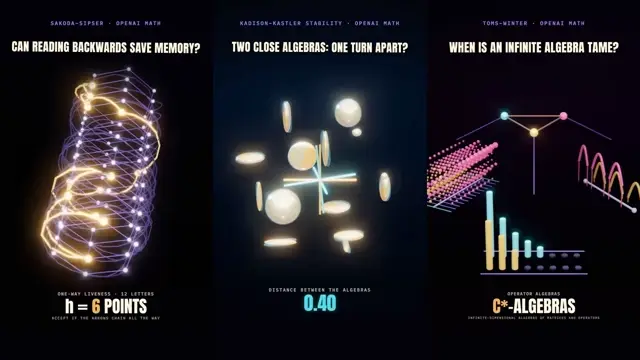
Strong Kadison–Kastler Stability: Two algebras of operators on the same space can be very close: every element of one lies near an element of the other.
Explained: gradientdamage.com/p/289
Paper: github.com/openai/math/blob/main/preprints/Universal-strong-K…
Toms–Winter Conjecture: The Toms–Winter conjecture predicts that three very different regularity properties of simple nuclear C*-algebras are the same: strict comparison (size decided by traces, like rank for matrices), finite nuclear…
Explained: gradientdamage.com/p/291
Paper: github.com/openai/math/blob/main/preprints/Tracial-projection…
Kirchberg's O2 Embedding Problem: The Cuntz algebra O2 is famously roomy: Kirchberg and Phillips proved that every separable exact C*-algebra fits inside it.
Explained: gradientdamage.com/p/292
Paper: github.com/openai/math/blob/main/preprints/An-explicit-obstru…
Kaplansky's Quasitrace Conjecture: A trace on a C*-algebra measures the size of its elements, and sizes add: the trace of x + y is the trace of x plus the trace of y.
Explained: gradientdamage.com/p/294
Paper: github.com/openai/math/blob/main/preprints/A-counterexample-t…
Generator Problem for von Neumann Algebras: Take two matrices and multiply them in every order.
Explained: gradientdamage.com/p/296
Paper: github.com/openai/math/blob/main/preprints/Relative-generatio…
Naimark's Problem: In 1948 Naimark asked whether a C*-algebra with only one irreducible representation, up to unitary equivalence, must be the algebra of compact operators K(H), the standard example.
Explained: gradientdamage.com/p/297
Paper: github.com/openai/math/blob/main/preprints/A-counterexample-t…
The Kirchberg–Rørdam Character Criterion: The Jiang–Su algebra Z behaves like an infinite-dimensional copy of the number 1 among C*-algebras, and absorbing it (A ⊗ Z ≅ A, "Z-stability") is central to the classification programme.
Explained: gradientdamage.com/p/299
Paper: github.com/openai/math/blob/main/preprints/The-Kirchberg-Rord…
Operator Paving: Paving asks whether a matrix (or operator) with zero diagonal can be cut into a few diagonal blocks that are each small.
Explained: gradientdamage.com/p/300
Paper: github.com/openai/math/blob/main/preprints/Quadratic-Strong-O…
Trace Cones Classify Razak–Jacelon Stabilizations: Every C*-algebra has traces, and its tracial weights form a cone.
Explained: gradientdamage.com/p/301
Paper: github.com/openai/math/blob/main/preprints/The-trace-cone-cla…
The animations illustrate the results; they are not proofs.
Gradient Damage: mathematics you can see, equations you can hear.
youtube.com/@gradientdamage
Chapters
One problem per chapter. Each name links to the result's own page, each time to that moment on YouTube.
- Strong Kadison–Kastler Stability Operator algebras
- Toms–Winter Conjecture Operator algebras
- Kirchberg's O2 Embedding Problem Operator algebras
- Kaplansky's Quasitrace Conjecture Operator algebras
- Generator Problem for von Neumann Algebras Operator algebras
- Naimark's Problem Operator algebras
- The Kirchberg–Rørdam Character Criterion Operator algebras
- Operator Paving Operator algebras
- Trace Cones Classify Razak–Jacelon Stabilizations Operator algebras
Chapter 1: about the problem
Operator algebras·OpenAI Math·Result 289
Strong Kadison–Kastler stability and its spatial boundaries
Proves that sufficiently close unital von Neumann algebras on the same Hilbert space are conjugate by a unitary arbitrarily close to the identity, with a universal tolerance in the operator-norm distance between unit balls. Counterexamples show that near-identity conjugacy fails for one-sided near inclusions, and that arbitrarily close norm-separable C∗-algebras need not be ambiently unitarily conjugate. (Lean)
Chapter 2: about the problem
Operator algebras·OpenAI Math·Result 291·from 0:21
Cuntz comparison, nuclear dimension, and equivariant Jiang–Su stability
Proves equivariant Jiang–Su stability for every countable discrete amenable group action on a simple separable unital infinite-dimensional nuclear stably finite Jiang–Su-stable C∗-algebra, resolving this case of Szabó's conjecture without restrictions on trace dynamics. The family also proves the unital Toms–Winter conjecture, equating strict comparison, finite nuclear dimension and Jiang–Su stability in the simple separable unital infinite-dimensional nuclear setting. (Lean)
Chapter 3: about the problem
Operator algebras·OpenAI Math·Result 292·from 0:43
Kirchberg's 𝒪2 norm-ultrapower embedding problem
Constructs an explicit separable unital full group C∗-algebra that cannot embed unitally into the norm ultrapower of any fixed nonzero unital nuclear C∗-algebra, for any free ultrafilter on the natural numbers. Taking the target to be 𝒪2 answers Kirchberg's norm-ultrapower embedding problem negatively. (Lean)
Chapter 4: about the problem
Operator algebras·OpenAI Math·Result 294·from 1:04
Kaplansky's quasitrace conjecture and failure of tensor-product stable finiteness
Disproves Kaplansky's quasitrace conjecture by constructing a separable unital complex C∗-algebra admitting normalized 2-quasitraces, all of which are nonadditive. As a consequence, two unital simple stably finite C∗-algebras can have a properly infinite minimal tensor product, with one factor Cr*(𝔽2). (Lean)
Chapter 5: about the problem
Operator algebras·OpenAI Math·Result 296·from 1:24
The generator problem for finite factors
Proves that every type II1 factor with separable predual is generated by a single operator, equivalently by two self-adjoint operators, resolving the generator problem. More strongly, for every irreducible inclusion P ⊂ M of such factors, the unitaries u with M=W*(P,u) form a dense Gδ subset in the trace 2-norm topology. (Lean)
Chapter 6: about the problem
Operator algebras·OpenAI Math·Result 297·from 1:45
A ZFC counterexample to Naimark's problem
Gives an alternative to Tanaka's ZFC construction of a unital infinite-dimensional simple complex C∗-algebra with a faithful tracial state and exactly one nonzero irreducible representation up to unitary equivalence. Thus the unrestricted compact-operator characterization fails without additional set-theoretic assumptions; the counterexample is nonseparable. (Lean)
Chapter 7: about the problem
Operator algebras·OpenAI Math·Result 299·from 2:05
The Kirchberg–Rørdam character criterion and infinite tensor-power Jiang–Su stability
A nonzero unital separable complex C∗-algebra is Jiang–Su stable exactly when its norm central-sequence algebra has no characters, for every free ultrafilter. This answers the Kirchberg–Rørdam character question. Also, the infinite minimal tensor power of every such algebra without characters is Jiang–Su stable, answering the Dadarlat–Toms question. (Lean)
Chapter 8: about the problem
Operator algebras·OpenAI Math·Result 300·from 2:26
Approximation and quadratic strong-operator paving
Proves that every self-adjoint element of a complex von Neumann algebra admits strong-operator paving relative to any maximal abelian subalgebra with O(ε-2) blocks. The norm bound holds after compression by a projection arbitrarily close to the identity in the strong topology, resolving the Popa–Vaes quadratic paving conjecture.
Chapter 9: about the problem
Operator algebras·OpenAI Math·Result 301·from 2:46
Trace cones and Razak–Jacelon stabilization
Classifies separable nuclear complex C∗-algebras after tensoring with the Razak–Jacelon algebra and the compact operators, using their full topological cones of extended lower-semicontinuous tracial weights. This answers Robert’s trace-cone question, including algebras with arbitrary ideal structure and both finite and infinite subquotients. (Lean)
Topics
Kadison-Kastler conjectureToms-Winter conjectureKirchberg embedding problemKaplansky quasitrace conjecturegenerator problemNaimark's problemKirchberg-Rørdampaving conjecturetrace coneOperator algebrasOpenAI mathAI proofAI mathematicsmathsGradient Damage