Short··0:21·Algebra
Kaplansky Zero-Divisor Conjecture: OpenAI Claims a Counterexample
Watch on YouTubeAbout the problem →
About this video
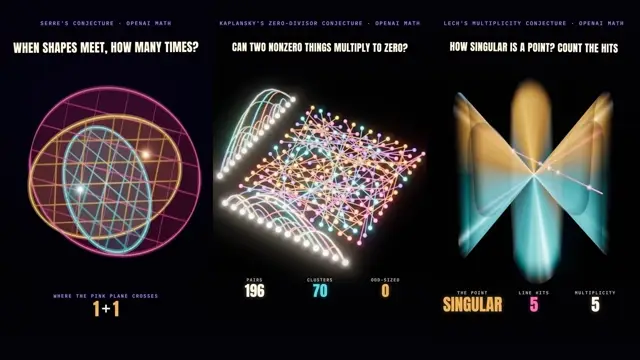
Kaplansky's zero-divisor conjecture (asked by Higman in 1940 and by Kaplansky in 1956) says that if a group G has no elements of finite order, its group algebra K[G] has no zero divisors: a·b = 0 forces a = 0 or b = 0. OpenAI claims a counterexample: a finitely presented torsion-free group G, with a finite two-dimensional classifying space, and nonzero a, b in F2[G] with a·b = 0. This is OpenAI's preprint, not yet peer reviewed. The animation is a small toy of the paper's parity trick with real data: two labelled graphs whose dots always share an odd number of labels (here, lines of the Fano plane), so every cluster of the 196 pairs has even size and the product cancels mod 2. It is a picture of the counting idea, not of the group itself.
Paper (OpenAI, catalogue result 196):
- A Torsion-Free Group Algebra with Zero Divisors: github.com/openai/math/blob/main/preprints/A-Torsion-Free-Gro…
The animation illustrates the result; it is not a proof.
Gradient Damage: mathematics you can see, equations you can hear.
youtube.com/@gradientdamage
Every result explained: gradientdamage.com/p/196
About the problem
Algebra·OpenAI Math·Result 196
A counterexample to Kaplansky’s zero-divisor conjecture
Constructs a finitely presented torsion-free group G whose group algebra 𝔽2[G] has nonzero zero divisors, disproving Kaplansky's zero-divisor conjecture. The group has a finite two-dimensional classifying space. (Lean)
Topics
Kaplansky zero divisor conjectureKaplansky conjectureszero divisorsgroup algebragroup ringtorsion-free groupF2[G]unit conjectureGardamHigmanfinitely presented groupgeometric group theoryalgebraOpenAIOpenAI mathAI mathematicsAI proofmathsmathematicsmath shorts3D animation