Short··0:49·Dynamical systems and ergodic theory
This equation can only end two ways
Watch on YouTubeAbout the problem →
About this video
One equation, two possible endings: silence, or the same loop forever. Every sound here is the oscillator's own motion x(t), sped up until you can hear it.
The equation is x'' + (x^4 - 10x^2 + 5)x'/10 + x = 0, a Liénard system. Start inside the inner loop and the motion dies away to rest. Start anywhere outside it and the motion settles onto the outer loop. Those two closed curves are its limit cycles.
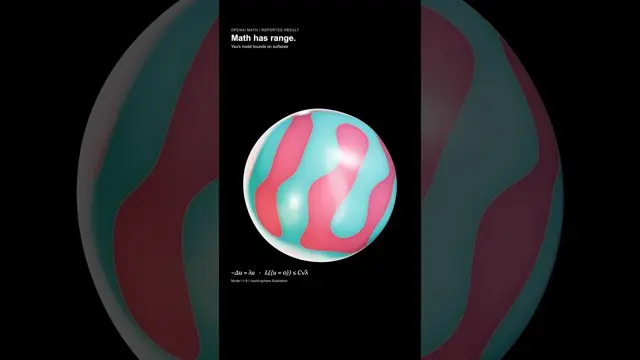
OpenAI, ChatGPT's creator, reports a proof that every classical Liénard system with F of degree at most five has at most two limit cycles. Examples with exactly two, like this one, are classical (Odani); the new claim is the upper bound. This is a source-reported result, not independently reviewed or proof-audited in this production, and the public ChatGPT product is not claimed to have proved it. The animation is a numerical illustration (RK4 integration), not the proof.
Source manuscript:
Two limit cycles for quintic Liénard systems
github.com/openai/math/blob/main/preprints/two-limit-cycles-f…
Corrections and withdrawals: github.com/openai/math/blob/main/history.md
Sound and visuals: original code-generated synthesis and animation. No third-party samples or compositions. Native 2160x3840 at 60 fps.
Gradient Damage: mathematics you can see, equations you can hear.
Visual maths, 3D animation and sound experiments.
youtube.com/@gradientdamage
About the problem
Dynamical systems and ergodic theory·OpenAI Math·Result 143
Hilbert's sixteenth problem: uniform bounds for limit cycles
Resolves the uniform boundedness assertion in Hilbert's sixteenth problem: the number of isolated periodic orbits of a real planar polynomial vector field is bounded by a finite constant depending only on its degree. For classical quintic Liénard systems, the exact maximum is two limit cycles. (Lean)
Topics
math soundslimit cyclesLienard equationdifferential equationsOpenAI mathmath animation